
Methane is a simple gas made of one carbon atom and four hydrogen atoms. Its chemical formula is CH4. Although methane is present in the atmosphere in much smaller amounts than carbon dioxide, it has a powerful warming effect. This is why methane matters in climate change.
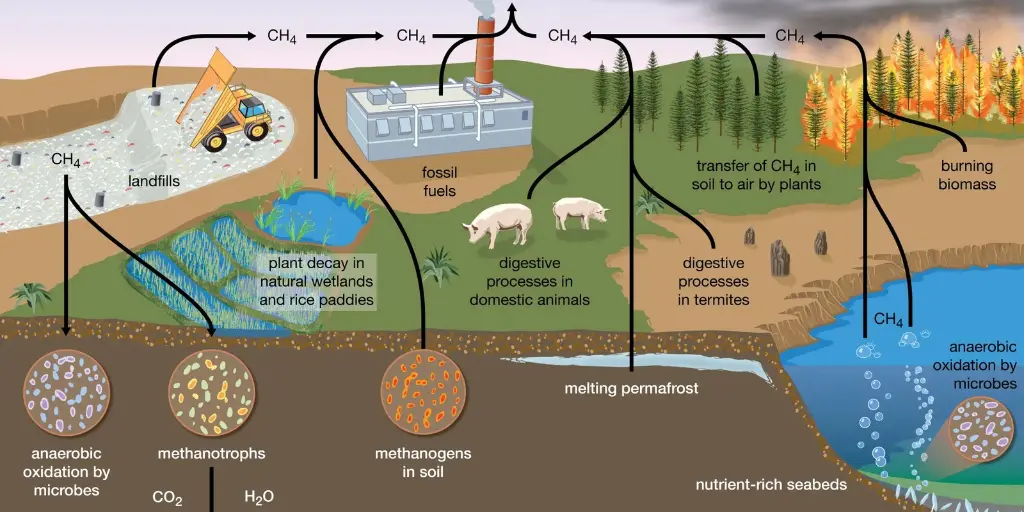
Methane is released by natural processes such as wetlands, and by human activities such as livestock farming, rice cultivation, landfills, coal mining, and the production and transport of oil and natural gas. Understanding where methane comes from, how it warms the atmosphere, and how its release can be reduced helps us understand an important part of the climate system.
Let Us Understand the Concept
What is methane?
Methane is a colourless and odourless gas at ordinary temperatures. It is the main component of natural gas and is also a hydrocarbon, meaning that it contains only carbon and hydrogen. Methane is highly flammable. When it burns completely in oxygen, it produces carbon dioxide, water, and energy.
The combustion equation is:
CH4 + 2O2 → CO2 + 2H2O + energy
This equation describes burning methane. However, methane can also affect climate when it is released directly into the atmosphere without being burned.
Why is methane a greenhouse gas?
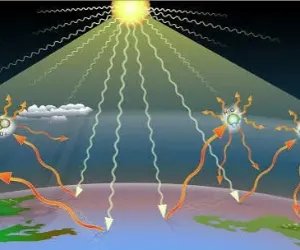
Sunlight passes through the atmosphere and warms Earth’s surface. The warm surface then gives off energy as infrared radiation, often called heat radiation. Greenhouse gases absorb some of this outgoing infrared energy and release it in different directions. Some of the energy returns towards Earth’s surface, making the lower atmosphere warmer.
Methane is a greenhouse gas because its molecules absorb particular wavelengths of infrared radiation. A single methane molecule is much more effective at trapping heat than a single carbon dioxide molecule. Methane is therefore called a potent greenhouse gas.
Carbon dioxide is more abundant and remains in the climate system for a very long time. Methane is less abundant and has a shorter atmospheric lifetime, but it produces strong warming while it is present. Both gases matter, and reducing methane emissions does not remove the need to reduce carbon dioxide emissions.
How long does methane remain in the atmosphere?
Methane remains in the atmosphere for about a decade, with an average atmospheric lifetime of roughly 12 years. This does not mean that all methane disappears exactly after 12 years. It means that chemical reactions remove methane from the atmosphere at an average rate over time.
The main removal process occurs when methane reacts with hydroxyl radicals in the atmosphere. These highly reactive substances help break methane down. The final products include carbon dioxide and water vapour. Because methane is changed into carbon dioxide during this process, its warming influence does not end immediately when the methane molecule is removed.
Methane also takes part in atmospheric reactions that increase ground-level ozone and affect the concentration of other gases. Ground-level ozone is an air pollutant that can harm human health, plants, and ecosystems. Thus, methane affects both climate and air quality.
Where does methane come from?
Methane has both natural sources and human-related sources.
Wetlands: Waterlogged soils often contain very little oxygen. Microorganisms called methanogenic archaea break down organic matter in these oxygen-poor conditions and produce methane. Wetlands are an important natural source.
Livestock: Cows, buffaloes, sheep, and goats digest fibrous plant material with the help of microorganisms in their digestive systems. This process, called enteric fermentation, produces methane that is released mainly through belching.
Rice fields: Flooded rice fields can become oxygen-poor below the surface. Microorganisms in the soil may then produce methane.
Landfills: Organic waste such as food scraps and garden waste decomposes without oxygen inside landfills. This anaerobic decomposition produces landfill gas, which contains methane and carbon dioxide.
Fossil-fuel systems: Methane can escape during the extraction, processing, storage, and transport of coal, oil, and natural gas. Unwanted releases are often called methane leaks or fugitive emissions.
Wastewater and biomass burning: Some wastewater treatment systems and incomplete burning of vegetation or other organic material can also release methane.
Why does methane cause warming so quickly?
Methane absorbs infrared radiation strongly. When its concentration increases, more outgoing heat is temporarily retained in the atmosphere. Methane also contributes to the formation of tropospheric ozone, which is itself a greenhouse gas.
Scientists compare greenhouse gases using global warming potential, or GWP. GWP compares the warming caused by a given mass of a gas with the warming caused by the same mass of carbon dioxide over a selected time period. The result depends on the time period used. Over 100 years, methane has roughly 27–30 times the warming effect of carbon dioxide per unit mass, depending on the methane source and the scientific assessment. Over 20 years, its effect is much larger because methane is especially powerful in the short term.
This explains an important point: reducing methane emissions can slow the rate of warming relatively quickly. However, carbon dioxide must also be reduced because it accumulates and can influence climate for centuries or longer.
Is all methane the same in relation to climate change?
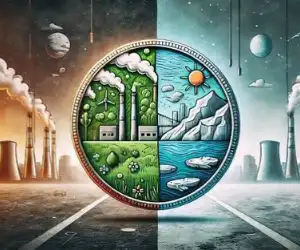
The methane molecule is chemically the same whether it comes from a wetland, a cow, or a natural-gas pipeline. The important difference is the source and the carbon cycle connected with that source.
Methane from plants, animals, wetlands, and other recent biological material is often called biogenic methane. The carbon in this methane recently came from atmospheric carbon dioxide through photosynthesis. Methane released from coal, oil, or natural gas contains carbon that has been stored underground for millions of years. Releasing it adds carbon to the active atmosphere–land–ocean system.
This distinction does not mean that biogenic methane is harmless. Both types warm the atmosphere while they are present. It helps scientists understand the source of emissions and design suitable solutions.
What happens when methane emissions increase?
- More methane enters the atmosphere from natural or human-related sources.
- The additional methane absorbs more outgoing infrared radiation.
- The atmosphere and Earth’s surface experience extra warming.
- Atmospheric chemical reactions convert methane into other substances, including carbon dioxide and water vapour.
- Methane-related chemistry can increase ground-level ozone and affect other greenhouse gases.
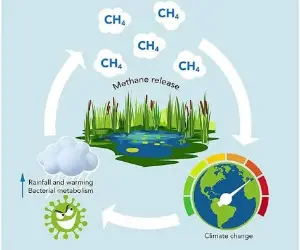
Climate change can also influence some methane sources. For example, changes in temperature, rainfall, wetland area, vegetation, and permafrost conditions may alter methane production. These interactions are complex, so scientists use measurements and climate models to study them.
How can methane emissions be reduced?
Methane reduction begins with identifying the source. In the oil and gas industry, regular leak detection and repair can prevent methane from escaping. Coal mines can collect methane and use it as a fuel or treat it safely. Landfill gas can be captured instead of released directly.
In agriculture, improved animal feed, better manure management, and covered storage systems can reduce methane from livestock operations. Rice farmers may use water-management methods that do not keep fields continuously flooded, where local conditions allow. Waste reduction, composting, and effective wastewater treatment can also lower methane formation.
These actions should be planned carefully. A method that reduces methane in one place must not create serious problems elsewhere. For example, collecting landfill methane can provide useful energy, but preventing organic waste from entering landfills is often a better long-term approach.
Why are both methane and carbon dioxide important?
Methane and carbon dioxide behave differently, but both contribute to global warming. Methane is short-lived and powerful, so cutting emissions can produce benefits over a relatively short period. Carbon dioxide is longer-lived and accumulates, so reducing carbon dioxide is essential for limiting long-term warming.
A useful way to remember this is: methane strongly affects the rate of warming, while carbon dioxide strongly affects the long-term amount of warming. This is a simplified summary, but it helps explain why climate solutions need to address both gases.
Important Scientific Terms and Their Meanings
Global warming potential: A comparison of the warming effect of a gas with carbon dioxide. The value changes depending on whether a 20-year or 100-year period is used. Wetland: Land that is covered or saturated with water for some or all of the year. Oxygen-poor wetland soils can produce methane.
| Scientific Term | Simple Meaning | Example or Explanation |
|---|---|---|
| Methane | A gas containing one carbon atom and four hydrogen atoms | Its chemical formula is CH4. |
| Greenhouse gas | A gas that absorbs some outgoing infrared radiation | Methane, carbon dioxide, and water vapour are greenhouse gases. |
| Greenhouse effect | Warming caused when gases retain some heat in the atmosphere | The natural greenhouse effect makes Earth suitable for life, but extra greenhouse gases cause additional warming. |
| Atmospheric lifetime | The average time a gas remains in the atmosphere before chemical removal | Methane has an average lifetime of roughly 12 years. |
| Anaerobic | Occurring without oxygen | Organic waste can produce methane during anaerobic decomposition. |
| Enteric fermentation | Microbial digestion in the digestive systems of some animals | It produces methane in cattle and other ruminants. |
| Biogenic methane | Methane produced from recently living biological material | Wetlands, livestock, and landfills can produce it. |
| Fugitive emissions | Unintended releases of gases during production or transport | Methane leaking from gas equipment is a fugitive emission. |
Examples or Activities
Example: Comparing two methane sources
Imagine a landfill containing food waste. Water fills some spaces between the waste, and oxygen becomes limited deep inside the landfill. Microorganisms break down the organic matter without oxygen and release methane. If a collection system captures this gas, it can be used as fuel or treated before release. This example connects anaerobic decomposition, methane production, and emission control.
Safe observation activity: Finding possible methane sources
Aim: To identify places where methane could be produced or released.
Materials required: A notebook, pencil, and an adult-approved observation area such as a school or home waste-management site.
Procedure:
- List nearby sources of organic waste, livestock, wastewater, or fuel use.
- Mark which sources may have little oxygen, such as waterlogged waste.
- Discuss how methane could be produced or released.
- Suggest one safe method of prevention or capture for each source.
Observation and explanation: Students may identify food waste, flooded soil, animal sheds, or fuel equipment. The activity does not measure methane and should not involve smelling, collecting, or igniting gas. It demonstrates how scientists begin by locating possible emission sources.
What Should We Understand from This Topic?
Methane matters because it is a powerful greenhouse gas that absorbs infrared radiation and contributes to warming. It is released by both natural systems and human activities. Its atmospheric lifetime is shorter than that of carbon dioxide, but its warming effect is strong, especially over short time periods. Methane also contributes to ground-level ozone formation. Reducing leaks, improving waste management, changing suitable farming practices, and managing methane from energy systems can slow near-term warming. Long-term climate protection still requires major reductions in carbon dioxide as well.
Key Points to Remember
- Methane has the chemical formula CH4.
- Methane is a powerful greenhouse gas because it absorbs infrared radiation.
- Important sources include wetlands, livestock, rice fields, landfills, coal mines, and oil and gas systems.
- Methane remains in the atmosphere for roughly 12 years on average.
- Methane can form ground-level ozone and eventually be converted into carbon dioxide and water vapour.
- Its global warming potential depends on the time period used for comparison.
- Reducing methane can slow the rate of warming relatively quickly.
- Reducing carbon dioxide remains essential for limiting long-term climate change.
- Both natural and human-related methane sources must be studied carefully.
Conclusion
Methane matters in climate change because a relatively small amount of this gas can produce a strong warming effect. Its sources are connected to wetlands, farming, waste, coal, oil, and natural gas. Learning how methane moves through the atmosphere shows why quick methane reductions and long-term carbon dioxide reductions are both necessary for a safer climate.