
Carbon dioxide, written as CO2, is a gas naturally present in Earth’s atmosphere. It is also released when humans burn coal, petroleum, and natural gas, and when forests are cleared. Although carbon dioxide makes up only a small part of the atmosphere, it has an important effect on Earth’s temperature because it interacts with infrared radiation, the type of energy associated with heat.
Understanding how carbon dioxide traps heat helps us understand the greenhouse effect, climate change, and why changes in atmospheric gases can affect ecosystems and human activities.
Let Us Understand the Concept
What is the greenhouse effect?
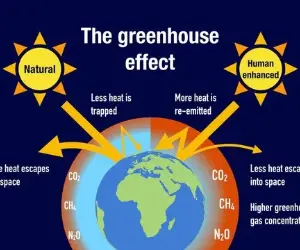
The greenhouse effect is the natural process by which certain gases in the atmosphere keep Earth warmer than it would be without them. These gases are called greenhouse gases. Important greenhouse gases include water vapour, carbon dioxide, methane, nitrous oxide, and ozone.
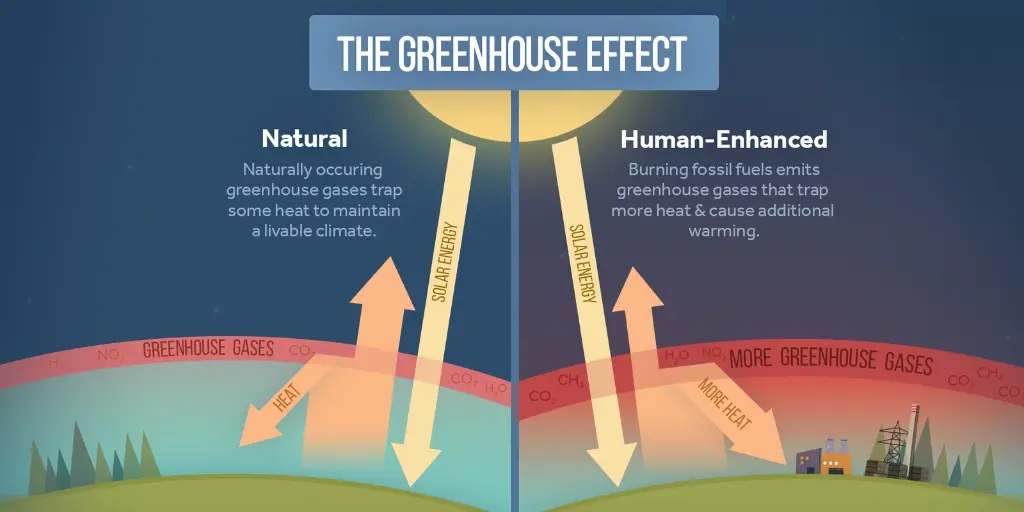
The greenhouse effect is not automatically harmful. The natural greenhouse effect makes Earth warm enough for liquid water and living organisms. The problem is that human activities have increased the concentration of several greenhouse gases, especially carbon dioxide. This strengthens the natural greenhouse effect and causes a long-term rise in average global temperature.
Step 1: Energy from the Sun reaches Earth
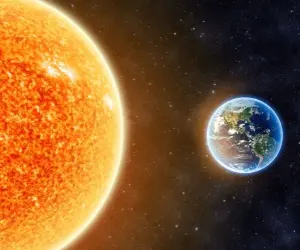
The Sun sends energy to Earth in the form of electromagnetic radiation. Much of this incoming energy is visible light and other shortwave radiation. Some sunlight is reflected back to space by clouds, ice, snow, and bright surfaces. The rest is absorbed by the atmosphere, land, and oceans.
Earth’s surface becomes warm after absorbing solar energy. Dark surfaces such as forests, soil, and roads generally absorb more sunlight than bright surfaces such as snow or ice.
Step 2: Earth gives energy back as infrared radiation
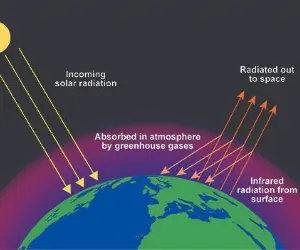
A warm object loses energy. After Earth’s surface absorbs sunlight, it releases energy upward as infrared radiation. Infrared radiation cannot usually be seen by our eyes, but we can feel some infrared energy as heat from a warm stove, a sun-heated wall, or a hot object.
Earth must eventually send energy back to space. If the energy coming in from the Sun is balanced by the energy leaving Earth, the planet’s average temperature remains fairly stable. Greenhouse gases affect how easily infrared energy escapes.
Step 3: Carbon dioxide absorbs some infrared radiation
Carbon dioxide molecules have a structure that allows them to absorb particular wavelengths of infrared radiation. When a CO2 molecule absorbs infrared energy, its atoms vibrate in specific ways. The molecule then transfers some of this energy to nearby molecules through collisions and can also emit infrared radiation.
This is the key point: carbon dioxide does not form a solid lid around Earth, and it does not stop all heat from leaving. Instead, it absorbs and re-emits certain wavelengths of outgoing infrared radiation, making the escape of energy to space less direct.
Step 4: Infrared energy is emitted in different directions
After absorbing infrared energy, a carbon dioxide molecule can emit infrared radiation in any direction. Some energy travels upward, and some travels downward toward Earth’s surface. The downward radiation adds energy to the surface and lower atmosphere.
Because CO2 molecules are continually absorbing and emitting radiation, energy may be transferred through many stages before it finally reaches space. This process is sometimes described as heat being trapped, but a more precise explanation is that greenhouse gases slow the loss of infrared energy to space.
Why does more carbon dioxide warm the planet?
Adding more carbon dioxide gives the atmosphere more molecules that can absorb infrared radiation. It also increases the distance that infrared energy can travel before reaching a level where it escapes to space.
The upper atmosphere is colder than the surface and lower atmosphere. When the effective level from which radiation escapes moves higher, radiation is emitted from a colder region. A colder region emits less infrared energy than a warmer region. Earth’s surface and lower atmosphere therefore warm until the planet is again releasing enough energy to balance the incoming solar energy.
This warming process is supported by the way temperature generally decreases with height in the lower atmosphere. The important idea is not that carbon dioxide creates energy. It changes the pathway and rate at which Earth’s existing energy leaves the climate system.
Why does carbon dioxide remain important even though water vapour is also a greenhouse gas?
Water vapour is the most abundant greenhouse gas, but its amount in the atmosphere changes quickly. Warm air can hold more water vapour, while cooling causes water vapour to condense into clouds or rain. For this reason, water vapour usually acts as a feedback rather than the main long-term control of Earth’s temperature.
Carbon dioxide can remain in the atmosphere for a much longer time and is directly added by human activities. When CO2 warms the atmosphere, the warmer air can hold more water vapour. The extra water vapour absorbs more infrared radiation and can produce additional warming. This is called a positive water-vapour feedback. It does not mean that water vapour starts the present warming by itself; the increase in carbon dioxide helps initiate the change.
What does the atmosphere do with different types of radiation?
Most greenhouse gases allow much of the incoming visible sunlight to pass through the atmosphere. However, they absorb some of the infrared radiation emitted by Earth’s surface. This difference is important. If greenhouse gases absorbed most incoming sunlight in the same way, the explanation would be different.
The atmosphere has an atmospheric window, a range of infrared wavelengths through which some surface radiation can escape relatively easily. Carbon dioxide absorbs strongly in particular infrared bands, including an important band near 15 micrometres. Other gases absorb different wavelengths. Together, these gases influence how much energy escapes directly and how much is absorbed and re-emitted.
Does carbon dioxide stop working after its absorption band becomes crowded?
This is a common misunderstanding. Some wavelengths near the centre of a CO2 absorption band are already strongly absorbed close to the surface. However, the edges of the absorption band are not absorbed as completely. Increasing the amount of CO2 strengthens absorption in these less-absorbed wavelengths and also changes the altitude from which radiation escapes.
The warming effect of each additional amount of CO2 becomes smaller compared with the previous equal amount, but it does not become zero. This is called a logarithmic relationship. In addition, warming can cause feedbacks involving water vapour, snow, ice, clouds, and oceans.
Natural and human-enhanced greenhouse effects
The natural greenhouse effect is essential. Without naturally occurring greenhouse gases, Earth’s average surface temperature would be much lower, and life as we know it would be difficult.
The enhanced greenhouse effect occurs when human activities increase greenhouse gas concentrations beyond their natural balance. Burning fossil fuels transfers carbon that was stored underground into the atmosphere as carbon dioxide. Cement production, deforestation, and some land-use changes also add CO2 or reduce the ability of ecosystems to remove it.
Plants absorb carbon dioxide during photosynthesis, and oceans also take up some CO2. These natural sinks slow the increase, but they do not remove all additional emissions. The remaining carbon dioxide accumulates in the atmosphere, changing the energy balance of the climate system.
Carbon dioxide and the carbon cycle
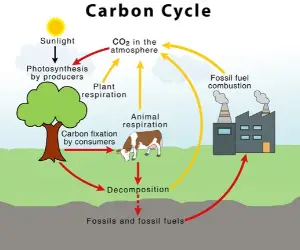
The carbon cycle is the movement of carbon among the atmosphere, living organisms, soil, oceans, and rocks. Plants remove carbon dioxide from the air during photosynthesis and use carbon to make carbohydrates. Respiration, decomposition, volcanic activity, and combustion return carbon dioxide to the atmosphere.
Human activities have rapidly transferred large amounts of carbon from geological stores into the atmosphere. Oceans absorb part of this extra carbon dioxide, but dissolved CO2 also contributes to ocean acidification. Therefore, increased carbon dioxide affects both atmospheric temperature and marine chemical conditions.
How do scientists know that carbon dioxide absorbs heat?
Scientists measure the absorption of infrared radiation by gases in laboratories and observe the wavelengths that different gases absorb. Instruments on the ground, aircraft, and satellites also measure outgoing infrared radiation from Earth.
These observations show the characteristic effects expected from greenhouse gases. Scientists also measure rising atmospheric CO2 concentrations, study carbon isotopes, observe changes in ocean heat and ice, and use physical climate models. The evidence from laboratory physics, atmospheric measurements, and climate observations fits together.
A simple comparison
Imagine a room with a heater and an open door. Energy enters the room from the heater and leaves through the door. If the doorway becomes narrower, energy leaves more slowly. The room warms until the energy leaving through the narrower opening again equals the energy supplied by the heater.
This comparison is not a perfect model of the atmosphere, because the atmosphere is not a simple door and greenhouse gases do not physically block all heat. It helps illustrate the main idea: carbon dioxide changes the rate at which energy leaves Earth, so the climate system must become warmer before it can release enough energy to space.
Important Scientific Terms and Their Meanings
| Scientific Term | Simple Meaning | Example or Explanation |
|---|---|---|
| Carbon dioxide | A gas made of one carbon atom and two oxygen atoms. | Its chemical formula is CO2, and it absorbs some infrared radiation. |
| Greenhouse gas | A gas that absorbs and emits infrared radiation. | Carbon dioxide, methane, and water vapour are greenhouse gases. |
| Greenhouse effect | The warming of Earth caused by atmospheric gases absorbing infrared radiation. | The natural greenhouse effect helps keep Earth suitable for life. |
| Infrared radiation | Electromagnetic radiation associated with thermal energy. | Earth’s warm surface emits infrared radiation. |
| Absorption | The taking in of energy by a substance. | CO2 absorbs particular wavelengths of infrared radiation. |
| Emission | The release of energy as radiation. | A CO2 molecule can emit infrared radiation after absorbing energy. |
| Radiation | Energy transferred through space or matter as electromagnetic waves. | Sunlight and infrared energy are forms of radiation. |
| Atmospheric window | A range of infrared wavelengths that can pass through the atmosphere relatively easily. | Some radiation escapes directly through this window. |
| Feedback | A process that strengthens or weakens an initial change. | Warming increases water vapour, which can add further warming. |
| Carbon sink | A natural system that absorbs more carbon than it releases. | Forests, soils, and oceans can act as carbon sinks. |
Examples or Activities
Example: Comparing sunlight and heat radiation
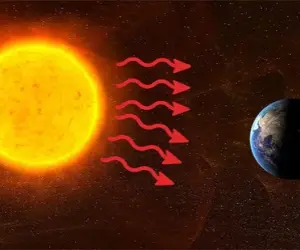
Place a dark-coloured object and a light-coloured object in sunlight, under safe adult supervision. After some time, the dark object will often become warmer because it absorbs more incoming sunlight. When both objects are warmer, they release infrared radiation. This simple observation shows that surfaces absorb solar energy and later release energy as heat. It does not by itself demonstrate the full atmospheric greenhouse effect, but it helps students distinguish incoming sunlight from outgoing infrared radiation.
Safe demonstration with warm objects
Aim: To understand that warm objects release infrared energy.
Materials: Two identical cups, warm water, room-temperature water, and a thermometer.
Procedure:
- Fill one cup with warm water and the other with room-temperature water.
- Measure and record their temperatures.
- Leave both cups in the same room for some time and measure them again.
Observation: The warm water cools, and the cooler water may warm slightly toward room temperature.
Explanation: Energy moves from the warmer object and surroundings toward the cooler ones. The warm cup loses energy through conduction, convection, and radiation. The activity does not model carbon dioxide directly, but it demonstrates that temperature is connected with energy transfer.
Conclusion: Earth’s surface also transfers energy, including by infrared radiation. Greenhouse gases influence how this outgoing infrared energy moves through the atmosphere.
What Should We Understand from This Topic?
Carbon dioxide traps heat in the sense that it absorbs and re-emits some of the infrared radiation leaving Earth. It does not create heat or prevent all energy from escaping. More CO2 makes the atmosphere more effective at absorbing particular wavelengths of outgoing infrared radiation. As a result, energy leaves the climate system more slowly. Earth’s surface and lower atmosphere warm until outgoing energy again balances incoming solar energy.
The natural greenhouse effect is necessary for life, but the human-caused increase in greenhouse gases strengthens it. Understanding this process requires considering radiation, atmospheric layers, the carbon cycle, and climate feedbacks together.
Key Points to Remember
- The Sun supplies energy mainly as shortwave radiation, including visible light.
- Earth’s warmed surface releases energy as longwave infrared radiation.
- Carbon dioxide absorbs particular wavelengths of outgoing infrared radiation.
- After absorbing energy, CO2 can emit infrared radiation in different directions.
- Greenhouse gases slow the loss of energy to space; they do not block all heat permanently.
- The natural greenhouse effect keeps Earth warmer and supports life.
- Human activities increase atmospheric CO2, strengthening the greenhouse effect.
- Water vapour, ice, snow, clouds, and oceans can create climate feedbacks.
- Carbon dioxide remains important because it can persist in the atmosphere for a long time and changes the climate system’s energy balance.
- More carbon dioxide continues to have a warming effect even though the strongest parts of some absorption bands are already highly absorbing.
Conclusion
Carbon dioxide warms Earth because its molecules absorb and re-emit infrared radiation released by the planet’s surface. This makes the escape of energy to space less efficient. The atmosphere therefore warms until it can once again release enough energy to balance sunlight entering the Earth system. The same natural process that makes Earth habitable becomes a climate problem when human activities add too much carbon dioxide to the atmosphere.