
A glacier is a large, long-lasting mass of moving ice formed from compacted snow. Glaciers grow when they gain more ice than they lose and shrink when ice loss is greater than ice gain. The phrase glacier retreat describes the movement of a glacier’s front, or terminus, farther up a valley or toward its source. It does not mean that the ice flows backwards. Instead, the glacier continues to flow downhill, but melting and ice loss at its lower end happen faster than new ice is supplied.
Understanding glacier retreat helps us connect the atmosphere, water cycle, landforms, ecosystems, and human activities. It is an important indicator of changes in Earth’s climate, although local snowfall, avalanches, shade, rock cover, and the shape of the ground beneath them can also affect individual glaciers.
Let Us Understand the Concept
What is a glacier?
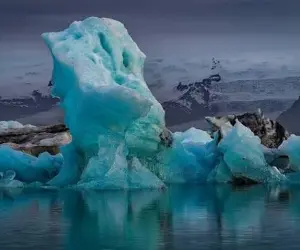
A glacier begins when snow remains on the ground for many years. In cold regions, new snow buries older snow. The pressure removes some air spaces and changes the snow into dense, granular ice called firn. With continued pressure, firn becomes solid glacial ice.
When the ice becomes thick enough, gravity pulls it downhill or outward. The ice may move slowly by deforming internally and by sliding over the ground. Therefore, a glacier is not a frozen river that stays still; it is a moving body of ice that stores freshwater and shapes the land.
Accumulation and ablation
The upper part of many glaciers is called the accumulation zone. Here, snowfall and other ice additions exceed melting and other losses over time. Snow may also reach this zone through wind transport or avalanches.
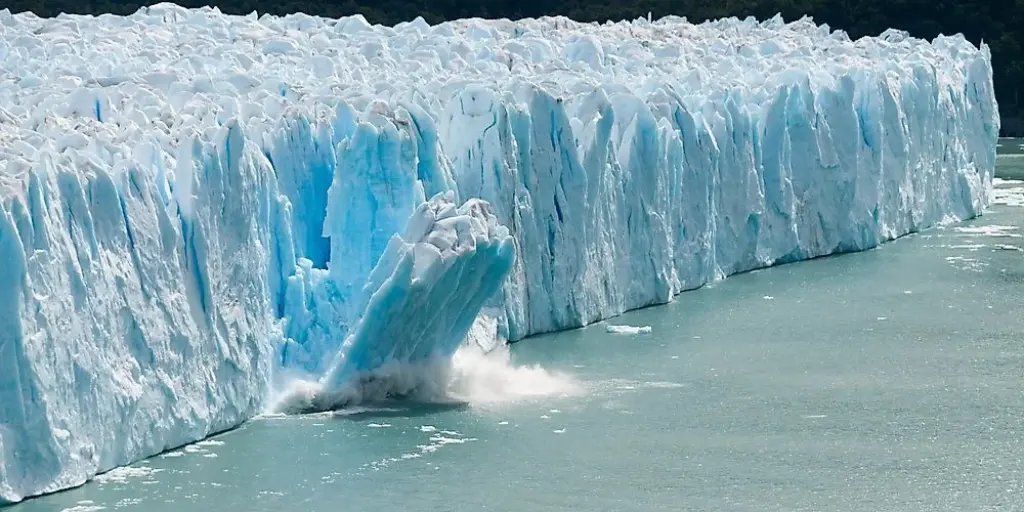
The lower part is called the ablation zone. Ablation means the loss of ice or snow. It can occur through surface melting, evaporation, sublimation, wind removal, and the breaking away of ice into water or floating icebergs, a process called calving.
The balance between ice gained and ice lost is called the mass balance. In simple form:
Mass balance = ice gain − ice loss
If the mass balance is positive, the glacier gains mass. If it is close to zero, the glacier is approximately stable. If it is negative for several years, the glacier loses mass and is likely to retreat.
How does a glacier retreat?
Imagine that a glacier flows down a valley. At its front, some ice melts or calves away. At the same time, ice from higher parts flows toward the front. If the amount arriving is equal to the amount lost, the front remains in roughly the same place.
Now suppose warmer conditions cause the lower glacier to lose ice faster. The ice flowing forward cannot replace all the lost ice. The front becomes thinner and moves toward higher ground. This is called retreat. The glacier is still flowing forward, but its terminus is losing position because ablation is greater than supply.
- Air or surrounding water becomes warm enough to increase melting.
- The glacier loses more ice at its surface, bottom, or front.
- Snowfall and ice flow from the upper glacier do not replace the loss.
- The glacier becomes thinner and its front shifts uphill or inland.
- If the imbalance continues, the glacier becomes smaller and stores less ice.
Why is rising temperature a major cause?
Higher air temperatures make it easier for snow and ice to melt, especially during warm seasons. Warmer conditions can also make the melting season longer. Snow that melts early exposes darker ice or rock. These darker surfaces absorb more sunlight than bright snow, which reflects much of the incoming solar energy. This increases heating and can cause additional melting.
Warming can affect glaciers even when the temperature is below the melting point. For example, warmer snowfall may contain wetter snow, and a change from snow to rain reduces the amount of fresh, reflective snow added to the glacier. Rain can also transfer heat to the ice surface. Over time, repeated warm seasons can create a negative mass balance.
How does snowfall affect glacier size?
Temperature is not the only factor. A glacier may lose ice when snowfall decreases, even if the temperature does not change greatly. Less snowfall means less ice enters the accumulation zone. If snowfall becomes more variable, a glacier may have several years in which losses are not replaced.
Snowfall also has a reflective effect. Clean, fresh snow reflects much of the sunlight that reaches it. When there is less snow, darker glacier ice is exposed and absorbs more energy. Thus, reduced snowfall can increase both the loss of ice supply and the absorption of solar heat.
Why do some glaciers lose ice by calving?
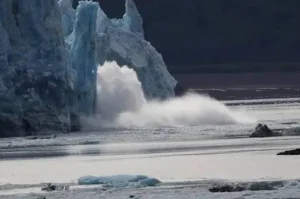
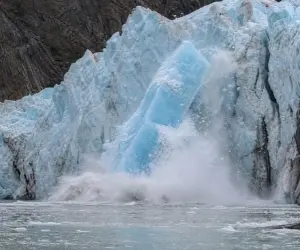
Glaciers that end in lakes or oceans may lose ice through calving. Large pieces break away from the front and become icebergs or floating ice blocks. Calving can increase when the front becomes unstable, when warmer water melts the glacier from below, or when cracks grow through the ice.
Calving is different from surface melting, but both remove glacier mass. A glacier floating on water may behave differently from one resting on solid ground. A retreating glacier that ends in a lake may also cause the lake to grow, which can change the rate of ice loss.
How do dark particles and rock debris affect melting?
Dust, soot, ash, and other dark particles can settle on snow and ice. Clean snow reflects a large amount of sunlight, but a darker surface absorbs more energy. This can speed up melting. Soot from burning fuels or vegetation may travel long distances in the atmosphere before being deposited on snow.
Rock debris has a more complicated effect. A thin layer of dark debris usually absorbs sunlight and increases melting. However, a thick layer can act like an insulating blanket and slow the transfer of heat into the ice. This is why two nearby glaciers may respond differently even under similar weather conditions.
Natural factors and glacier response
Glaciers do not all respond at the same speed. A glacier’s size, thickness, slope, elevation, surface colour, amount of debris, and connection to a lake or ocean all matter. A glacier in a shaded valley may melt more slowly than one exposed to direct sunlight. A glacier fed by frequent avalanches may receive extra snow even when regional snowfall is low.
Glaciers can also advance for short periods because of heavy snowfall, colder weather, or changes in ice flow. Such a local advance does not automatically disprove long-term global warming. Scientists study measurements over many years, including changes in length, thickness, area, snowfall, temperature, and mass balance.
What are the effects of glacier retreat?
Glaciers are natural stores of freshwater. During warm seasons, meltwater can supply streams and rivers used by plants, animals, farms, and people. At first, increased melting may raise river flow. Later, if the glacier becomes much smaller, there may be less ice available to melt during dry or hot periods.
Retreat can also change mountain ecosystems. New land may become available for plants, but cold-water organisms can lose suitable habitat. Meltwater lakes may expand behind unstable ice or rock, creating a risk of sudden floods. As glaciers shrink, they can expose rocks, reshape valleys, and alter sediment movement in rivers.
Glacier retreat is one sign of a changing climate, but it is not itself the same as sea-level rise in every situation. Melting land-based glaciers add water to the oceans and contribute to sea-level rise. Floating ice already displaces water, so its melting has a much smaller direct effect on sea level, although changes in floating ice can influence the flow of land ice behind it.
How do scientists measure retreat?
Scientists compare the position of a glacier’s terminus using field surveys, maps, aerial photographs, and satellite images. They also measure snow accumulation, melting, ice thickness, and the speed of ice movement. A glacier may retreat many metres in one year and less in another, so long-term records are important.
Scientists often use the term glacier length change for the movement of the front. A length change is an observable result, while a negative mass balance explains the loss of ice that often causes it. These measurements help researchers separate short-term weather effects from long-term climate patterns.
Important Scientific Terms and Their Meanings
| Scientific Term | Simple Meaning | Example or Explanation |
|---|---|---|
| Glacier | A large, moving mass of ice formed from compacted snow. | It flows slowly downhill under gravity. |
| Terminus | The front or lower end of a glacier. | Retreat means this front shifts toward the glacier’s source. |
| Accumulation | The addition of snow and ice to a glacier. | Snowfall and avalanches can add mass. |
| Ablation | The loss of snow or ice. | Melting, sublimation, and calving are forms of ablation. |
| Mass balance | The difference between ice gained and ice lost. | A negative mass balance means the glacier is shrinking overall. |
| Firn | Old, compacted snow that has not yet become solid glacial ice. | Pressure gradually changes firn into ice. |
| Calving | The breaking away of ice from a glacier front. | It can produce icebergs in lakes or oceans. |
| Sublimation | Change of ice directly into water vapour. | It can remove ice without liquid water forming first. |
| Albedo | The ability of a surface to reflect sunlight. | Fresh snow has high albedo; dark ice has lower albedo. |
| Meltwater | Water produced when snow or ice melts. | It may enter streams and lakes. |
| Ice flow | The slow movement of glacier ice. | Gravity drives flow downhill or outward. |
Examples or Activities
Safe classroom model of glacier retreat
Aim: To model how a glacier front changes when ice loss is greater than ice supply.
Materials Required: A shallow tray, a few ice cubes, a small amount of clean sand or crushed biscuit, a ruler, and a room-temperature surface. Use adult supervision and do not eat materials after the activity.
Procedure:
- Place several ice cubes close together on the tray to represent a small glacier.
- Mark the position of the front edge with a ruler.
- Place the tray in a warm room and observe it at regular intervals.
- Record the position of the front edge and the amount of melted water.
- Compare the initial and later positions.
Observation: The ice becomes smaller, and water collects around it. The front edge may move backwards as ice melts.
Explanation: The model demonstrates ice loss, but it does not reproduce real glacier flow, snowfall, pressure, or calving perfectly. In an actual glacier, the front retreats when ice loss is greater than the ice supplied by snowfall and flow from higher areas.
Conclusion: A change in the position of the ice front is a visible result of an imbalance between ice gain and ice loss.
What Should We Understand from This Topic?
Glacier retreat is mainly controlled by the glacier’s mass balance. A glacier retreats when melting, sublimation, calving, or other losses exceed the addition of snow and ice. Rising temperatures can increase melting and lengthen the melt season, while changes in snowfall reduce the supply of new ice. Dark particles can increase sunlight absorption, and local conditions such as debris, slope, shade, avalanches, and water contact can change the response of individual glaciers.
The important point is that retreat describes the changing position of the terminus, not a reversal of ice flow. Ice may still move downhill while the glacier as a whole becomes shorter and thinner.
Key Points to Remember
- A glacier is a slow-moving mass of ice formed from compacted snow.
- The accumulation zone gains snow and ice, while the ablation zone loses snow and ice.
- Mass balance equals ice gain minus ice loss.
- A negative mass balance usually causes a glacier to become thinner and retreat.
- Glacier retreat does not mean that the ice flows uphill or backwards.
- Warmer air, warmer water, reduced snowfall, rain, soot, and dark surfaces can increase ice loss.
- Calving is the breaking away of ice from a glacier front.
- Local conditions can make glaciers retreat at different rates.
- Land-based glacier melt adds water to the oceans and can contribute to sea-level rise.
- Scientists use field measurements, photographs, maps, and satellites to track glacier change.
Conclusion
Glaciers retreat when they lose more ice than they gain over time. The main cause of widespread modern retreat is a long-term imbalance linked largely to warming conditions, although snowfall and local geography also matter. By studying glacier mass balance and terminus movement, scientists can understand changes in Earth’s climate, water resources, landscapes, and ecosystems.