

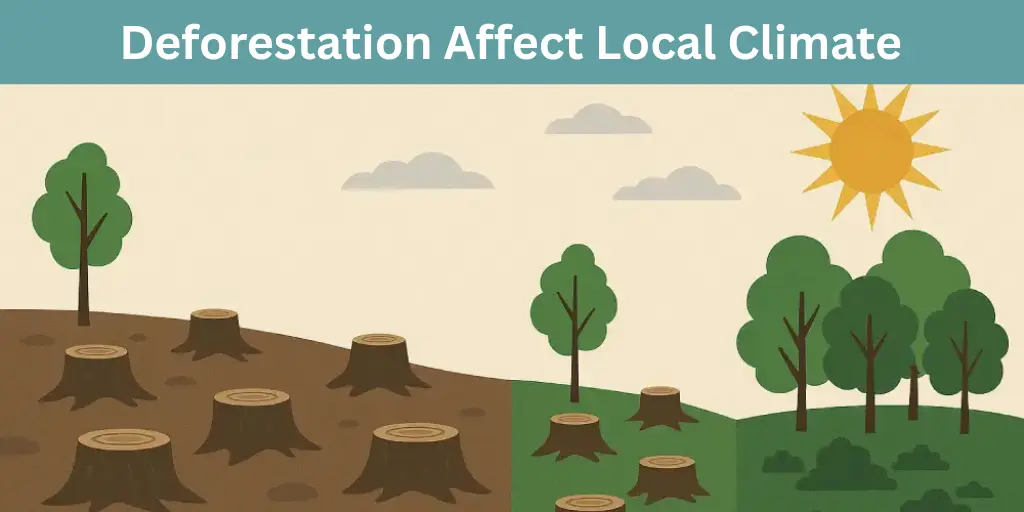
Deforestation means the large-scale removal of trees and forests so that the land can be used for farming, roads, buildings, mining, or other activities. Forests do much more than provide wood. They influence temperature, humidity, rainfall, wind movement, soil moisture, and the storage of carbon.
When a forest is removed, the local environment changes. The land may become hotter and drier during the day, rainfall patterns may change, and soil can lose moisture more quickly. These effects are called changes in the local climate. Local climate means the usual pattern of temperature, humidity, rainfall, wind, and other atmospheric conditions in a particular area over a long period.
To understand how deforestation affects local climate, we must study how trees interact with sunlight, water, air, soil, and the atmosphere.
Let Us Understand the Concept
What Is Deforestation?
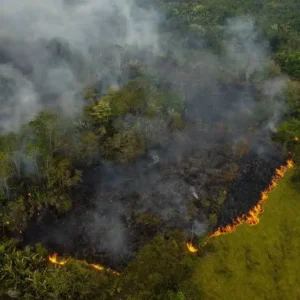
Deforestation is the permanent or long-term clearing of forests. A small number of trees may be removed without causing major environmental change, but removing a large area of forest can disturb the balance of an ecosystem.
Deforestation may occur when forests are cleared for crop cultivation, cattle grazing, settlements, industries, roads, dams, or mining. Sometimes trees are also cut for fuelwood and timber. If new trees do not grow in place of the removed trees, the area gradually loses its forest characteristics.
Weather and Local Climate
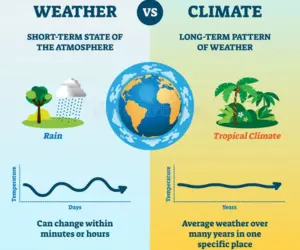
Weather describes the conditions of the atmosphere at a particular time, such as today’s temperature or rainfall. Climate describes the average pattern of weather in a place over many years.
Cutting trees may not change the weather every day in exactly the same way. However, if a large forest is removed, the average conditions of the area can change over time. This may result in higher average daytime temperatures, lower humidity, altered rainfall, and increased dryness.
Trees Cool the Local Environment
Trees help cool the surrounding air in two important ways. First, their leaves provide shade and prevent some sunlight from directly heating the ground. Second, trees release water vapour into the air through a process called transpiration.
During transpiration, roots absorb water from the soil. Some of this water travels through the stem to the leaves and escapes through tiny openings called stomata. Changing liquid water into water vapour requires energy. Much of this energy comes from heat in the surroundings, so transpiration produces a cooling effect.
When forests are cleared, there are fewer leaves to provide shade and less water vapour released by plants. The ground and nearby air can therefore become warmer, especially during sunny days.
Evapotranspiration and Humidity
The combined loss of water vapour from plant transpiration and evaporation from soil, ponds, and other wet surfaces is called evapotranspiration. Forests usually have a large amount of vegetation and leaf surface, so they contribute strongly to evapotranspiration.
Water vapour is a major source of humidity in the lower atmosphere. A forest can return a considerable amount of water to the air, where it may later form clouds and contribute to rainfall. After deforestation, evapotranspiration decreases. The air may become less humid, and cloud formation may be affected.
This does not mean that every cleared area immediately stops receiving rain. Rainfall is also controlled by oceans, wind patterns, mountains, large-scale atmospheric circulation, and nearby water bodies. However, removing a large forest can reduce the moisture supplied by the land and may make local rainfall less regular or less intense in some situations.
How Forests Participate in the Water Cycle
The water cycle is the continuous movement of water between the atmosphere, land, rivers, lakes, oceans, soil, and living organisms. Forests are active parts of this cycle.
- Rain falls onto the forest canopy and the ground.
- Roots absorb some of the water from the soil.
- Water moves through stems and reaches the leaves.
- Leaves release some water vapour through transpiration.
- The water vapour enters the atmosphere and may help form clouds.
- Some water flows slowly through the soil and reaches streams and groundwater.
Deforestation interrupts several of these steps. With fewer roots and leaves, less water is stored in vegetation and soil. More rainwater may run quickly over the surface instead of entering the ground. This can increase flooding during heavy rain, while the area may have less available soil water during dry periods.
Changes in Temperature
Forest removal can produce different temperature effects during the day and night. In a forest, shade and transpiration reduce daytime heating. After clearing, exposed soil, rocks, roads, and buildings may absorb more solar energy and become hot.
However, the exact temperature change depends on the replacement land cover. Cropland, grassland, bare soil, and urban surfaces behave differently. Some cleared areas may also lose heat quickly at night. Therefore, it is more accurate to say that deforestation changes the local energy balance and often increases daytime heat and dryness, rather than claiming that temperatures always rise at every hour.
The albedo of a surface is the fraction of sunlight it reflects. Different surfaces have different albedos. A change from dark forest to light-coloured soil or grass can alter how much sunlight is reflected and how much energy is absorbed. This is one reason land-cover change can influence local temperature.
Effects on Rainfall
Forests can influence rainfall by adding water vapour to the atmosphere and by affecting air movement. Warm, moist air can rise, cool, and condense into cloud droplets. If enough droplets join together, precipitation such as rain may occur.
After deforestation, there may be less moisture available for this process. Reduced vegetation can also change the roughness of the land surface, which affects wind movement. In some regions, the loss of forest moisture recycling can contribute to reduced or delayed rainfall. The result is not identical everywhere because local climate also depends on geography and regional weather systems.
Soil, Runoff, and Local Climate
Tree roots hold soil particles together and help water enter the ground. Leaves and fallen branches form a layer of organic material that protects the soil from direct rain impact. When trees are removed, this protection decreases.
Rainwater may then flow rapidly across the surface. This is called surface runoff. Runoff can carry away fertile topsoil, a process known as soil erosion. Eroded soil may enter streams and make the water muddy. Less water may remain in the soil for plants, which can make the cleared land hotter and drier.
The loss of soil moisture can create a feedback effect. Dry soil supports less vegetation, and less vegetation means less transpiration and shade. As a result, the land may become even more vulnerable to heat and dryness.
Effects on Carbon and the Atmosphere
Trees absorb carbon dioxide from the atmosphere during photosynthesis. They use sunlight to convert carbon dioxide and water into glucose, while releasing oxygen. Carbon becomes stored in trunks, branches, roots, leaves, and soil.
When forests are cut and burned or left to decay, some of this stored carbon is released into the atmosphere as carbon dioxide. Carbon dioxide is a greenhouse gas, meaning it absorbs and re-emits some heat energy in the atmosphere. Deforestation therefore contributes to global climate change as well as local environmental changes.
Global climate change can then influence local temperature, rainfall, drought, and extreme weather. Thus, deforestation has both direct local effects, such as loss of shade and moisture, and wider effects caused by changes in atmospheric greenhouse gases.
Effects on Wind and Air Movement
A forest canopy and tree trunks create friction that slows and redirects air near the ground. When the forest is removed, the surface becomes more open. Wind may move more freely across the land, increasing the drying of soil and plants.
Forests also create differences in temperature between shaded and open areas. These differences can affect small-scale air circulation. Removing the trees changes these temperature and wind patterns, although the size of the effect depends on the area cleared and the surrounding landscape.
Why the Effects Differ from Place to Place
Deforestation does not produce the same climate effect everywhere. Important factors include the size of the cleared area, the type of forest, the local soil, the replacement vegetation, the season, topography, and the distance from oceans or large lakes.
Clearing a small patch may affect the immediate surroundings, while clearing a very large connected forest can influence moisture movement over a much wider region. A forest replaced by irrigated crops may have a different local effect from a forest replaced by bare ground or concrete. Scientific studies therefore examine local measurements and long-term climate records rather than using one simple rule for every location.
How Deforestation Can Be Reduced
The effects of deforestation can be reduced through conservation and responsible land management. Protecting existing forests is especially important because mature forests provide complex benefits that young plantations may take many years to develop.
- Prevent unnecessary clearing of natural forests.
- Plant and protect native trees in suitable areas.
- Use agroforestry, in which trees are grown together with crops or livestock.
- Restore damaged land and protect soil from erosion.
- Use wood and paper efficiently and recycle when possible.
- Create wildlife corridors and protect forest watersheds.
- Include local communities in forest conservation and sustainable use.
Tree planting helps, but it is not a complete replacement for protecting an existing forest. New trees need time to develop deep roots, a layered canopy, rich soil, and a stable ecosystem.
Important Scientific Terms and Their Meanings
| Scientific Term | Simple Meaning | Example or Explanation | |
|---|---|---|---|
| Deforestation | Large-scale removal of forests | Clearing trees for farming, roads, buildings, or mining. | |
| Local climate | The long-term pattern of atmospheric conditions in a particular area | Average temperature, humidity, rainfall, and wind of a place. | |
| Transpiration | Release of water vapour from plant leaves | Water escapes through tiny openings called stomata. | |
| Evapotranspiration | Water loss through evaporation and transpiration together | It adds moisture to the air from soil and vegetation. | |
| Humidity | The amount of water vapour in the air | Humid air contains more water vapour than dry air. | |
| Albedo | The ability of a surface to reflect sunlight | Different surfaces reflect different amounts of solar energy. | |
| Surface runoff | Water flowing over the land surface | Heavy runoff can cause flooding and soil erosion. | |
| Soil erosion | Removal of topsoil by water or wind | Loss of trees can leave soil exposed to rain. | |
| Photosynthesis | The process by which green plants make food using light | Plants use carbon dioxide and water to make glucose and release oxygen. | |
Examples or Activities
Activity: Comparing Shaded and Exposed Surfaces
Aim: To observe how shade affects the heating of surfaces.
Materials Required: Two similar containers, soil, a thermometer if available, and a shaded place with vegetation and an open sunny place.
Procedure:
- Fill both containers with similar amounts of soil.
- Place one container under a tree or in a shaded area and the other in direct sunlight.
- Leave them in the same conditions for a suitable period.
- Carefully compare their temperatures using a thermometer, if available. Do not touch very hot surfaces.
Observation: The soil exposed to direct sunlight will generally become warmer than the shaded soil.
Explanation: Shade blocks some sunlight, so less solar energy reaches the shaded soil. In a real forest, the canopy also works with transpiration to reduce heating.
Conclusion: Vegetation can help moderate the temperature of the ground and nearby air. This simple activity does not represent every part of a forest climate system, but it demonstrates the cooling role of shade.
Real-Life Example
Imagine a forested area beside a stream being cleared for construction. Without tree crowns, the soil receives more sunlight. Without roots and leaf litter, rainwater runs away faster and carries soil into the stream. With fewer leaves, less water vapour enters the air. The cleared area may therefore become hotter, drier, more prone to erosion, and less able to maintain a steady flow of water during dry periods.
What Should We Understand from This Topic?
Deforestation affects local climate because forests regulate exchanges of energy and water between the land and the atmosphere. Trees shade the ground, cool the air through transpiration, add moisture through evapotranspiration, store carbon, slow runoff, and influence wind movement.
When trees are removed, these functions become weaker. The land may absorb more heat, lose water more quickly, and experience changes in humidity and rainfall. Soil erosion and reduced groundwater recharge can make the effects stronger. At the same time, the release of stored carbon contributes to global climate change, which can create additional pressure on local climate systems.
Key Points to Remember
- Deforestation is the large-scale clearing of forests.
- Forests influence local temperature, humidity, rainfall, wind, soil moisture, and water flow.
- Tree leaves provide shade and cool the surroundings through transpiration.
- Evapotranspiration adds water vapour to the atmosphere and may support cloud formation.
- Deforestation can reduce humidity and change local rainfall patterns, although the result differs by region.
- Without roots and leaf litter, surface runoff and soil erosion usually increase.
- Changing forest cover changes the surface albedo and the amount of solar energy absorbed.
- Trees store carbon, while burning or decomposing forest material can release carbon dioxide.
- Deforestation has direct local effects and also contributes to wider global climate change.
- Protecting natural forests and restoring damaged land are important climate and environmental solutions.
Conclusion
Deforestation is not only the loss of trees; it is the loss of a natural system that regulates heat and water. Forests cool the land, return moisture to the atmosphere, protect soil, and store carbon. Removing them can make local conditions hotter, drier, and less stable. Understanding these connections shows why forest conservation is important for ecosystems, people, and climate.