
The greenhouse effect is a natural process that helps keep Earth warm enough for life. It happens when certain gases in the atmosphere absorb and re-emit some of the heat energy released by Earth’s surface. Without this natural effect, Earth would be much colder. However, human activities have increased the amount of some greenhouse gases, strengthening the effect and contributing to global warming and climate change.
In this lesson, we will understand how sunlight reaches Earth, how Earth releases heat, how greenhouse gases trap some of that heat, and why the balance of these processes matters.
Let Us Understand the Concept
What is the greenhouse effect?
The greenhouse effect is the warming of Earth’s lower atmosphere and surface because certain gases absorb and re-emit outgoing infrared radiation. Infrared radiation is a type of invisible energy that we commonly experience as heat.
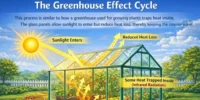
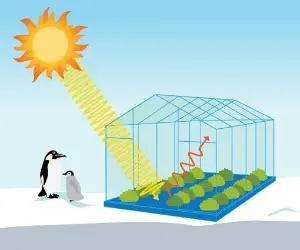
The name comes from a greenhouse used for growing plants. A glass greenhouse allows sunlight to enter and helps keep the inside warm. However, Earth’s atmosphere does not work exactly like the glass of a greenhouse. The comparison is useful because both systems allow incoming sunlight to enter and reduce the loss of heat, but the actual atmospheric process mainly involves the absorption and re-emission of infrared radiation by gases.
Step 1: Energy from the Sun reaches Earth
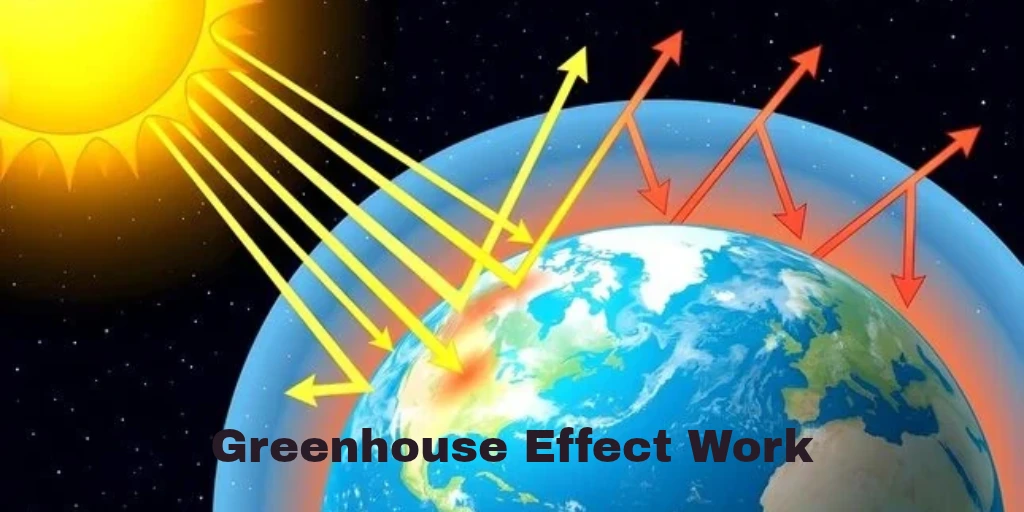
The Sun is Earth’s main source of energy. It sends energy through space in the form of electromagnetic radiation. A large part of the incoming solar energy is visible light, although ultraviolet and other types of radiation are also present.
When sunlight reaches Earth, some of it is reflected back into space by clouds, snow, ice, deserts, and other bright surfaces. The rest is absorbed by the land, oceans, and living things. Absorbed solar energy warms Earth’s surface.
Step 2: Earth’s surface releases heat
After being warmed by sunlight, Earth’s surface does not keep all the energy forever. It releases energy back toward the atmosphere and space as infrared radiation. This is different from the visible light arriving from the Sun because it has longer wavelengths and is mainly felt as heat.
For Earth’s average temperature to remain stable over a long period, the energy entering the Earth system must be balanced by the energy leaving it. If more energy remains in the Earth system than leaves, the planet warms. If more energy leaves than enters, the planet cools.
Step 3: Greenhouse gases absorb some outgoing heat
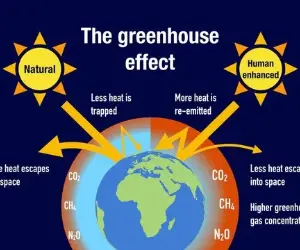
Some gases in the atmosphere can absorb infrared radiation. These are called greenhouse gases. Important greenhouse gases include water vapour, carbon dioxide, methane, nitrous oxide, ozone, and certain industrial gases.
When a greenhouse gas molecule absorbs infrared energy, it gains energy and begins vibrating or moving in an excited state. It can then release the energy again as infrared radiation in different directions. Some of this energy travels upward toward space, while some returns toward Earth’s surface.
Step 4: Heat is re-emitted in different directions
Because greenhouse gases re-emit infrared radiation in all directions, some heat energy is sent back toward the surface. This does not mean that greenhouse gases create energy. They only affect how quickly energy escapes from Earth to space.
The repeated absorption and re-emission of infrared energy slows the loss of heat. As a result, Earth’s surface and lower atmosphere become warmer than they would be without greenhouse gases.
Why is the natural greenhouse effect necessary?
The natural greenhouse effect is essential for life. Earth receives energy from the Sun, but without an atmosphere containing greenhouse gases, much more heat would escape directly into space. Earth’s average surface temperature would be far below the present average, and many forms of life could not survive in their current habitats.
Water vapour is the most abundant greenhouse gas and is an important part of Earth’s natural climate system. Carbon dioxide is present in a smaller amount, but it plays a major role because it remains in the atmosphere for a long time and helps regulate the planet’s temperature.
How do human activities strengthen the greenhouse effect?
Human activities have increased the concentration of several greenhouse gases in the atmosphere. The major source of additional carbon dioxide is the burning of coal, petroleum, and natural gas for electricity, transport, industries, and heating. Cutting and burning forests also releases carbon dioxide and reduces the number of trees available to remove it from the atmosphere through photosynthesis.
Methane is released from sources such as livestock digestion, rice cultivation, landfills, and the production and transport of fossil fuels. Nitrous oxide is associated with some agricultural and industrial activities. Certain human-made gases used in refrigeration and industry can also act as powerful greenhouse gases.
As the amount of greenhouse gases increases, the atmosphere absorbs more outgoing infrared radiation. The energy balance changes because less heat escapes to space at first. Earth’s surface and lower atmosphere then warm until they release enough additional energy to restore balance at a higher temperature.
Greenhouse effect, global warming, and climate change
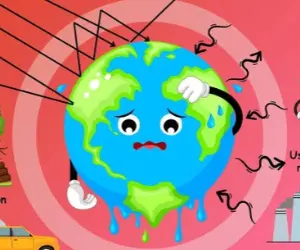
These three terms are related but do not mean the same thing.
- Greenhouse effect: The natural process by which greenhouse gases warm Earth by absorbing and re-emitting infrared radiation.
- Global warming: The long-term rise in Earth’s average surface temperature, especially due to the increase of human-produced greenhouse gases.
- Climate change: Long-term changes in temperature, rainfall, wind patterns, sea level, ice cover, and other parts of the climate system. Global warming is one important part of climate change.
The greenhouse effect itself is not harmful. The problem is the enhanced greenhouse effect, in which extra greenhouse gases increase the warming influence beyond the natural level.
Why does carbon dioxide matter?
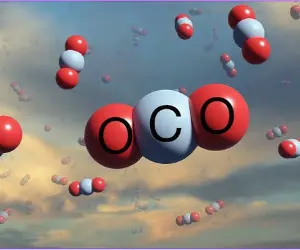
Carbon dioxide is naturally added to the atmosphere by respiration, volcanic activity, and decomposition. It is naturally removed when plants absorb it during photosynthesis and when oceans take up some of it. Human activities have disturbed this balance by releasing carbon dioxide faster than natural systems can remove it.
Carbon dioxide molecules absorb specific wavelengths of infrared radiation. Even though carbon dioxide forms only a small fraction of the atmosphere, its ability to absorb heat, its long atmospheric lifetime, and the large quantity released by human activities make it scientifically important.
What is the role of water vapour?
Water vapour is a greenhouse gas, but its amount in the atmosphere is strongly controlled by temperature. When air becomes warmer, it can generally hold more water vapour. Extra water vapour can then strengthen warming because it absorbs infrared radiation. This is called a feedback, meaning that an initial change causes further changes in the same system.
Water vapour is mainly a feedback rather than the original long-term cause of the present human-driven warming. Carbon dioxide and other long-lived gases can remain in the atmosphere and cause warming, which then allows more water vapour to enter the atmosphere.
What happens to clouds and ice?
Clouds can reflect some sunlight to space, producing a cooling effect, and can also absorb outgoing infrared radiation, producing a warming effect. The overall effect of clouds depends on their type, height, thickness, and location.
Ice and snow reflect a large amount of sunlight. When warming causes ice or snow to melt, darker land or ocean surfaces may be exposed. These darker surfaces absorb more sunlight, which can cause additional warming. This is called the ice-albedo feedback.
A simple way to remember the process
- Sunlight travels from the Sun to Earth.
- Earth’s surface absorbs some of the sunlight and becomes warm.
- The warm surface releases infrared radiation.
- Greenhouse gases absorb some of this outgoing infrared radiation.
- The gases re-emit infrared radiation in different directions.
- Some energy returns toward the surface, slowing heat loss to space.
Remember that greenhouse gases do not form a solid lid around Earth, and they do not trap all heat permanently. They allow energy to escape, but they make the escape process slower.
Important Scientific Terms and Their Meanings
Global warming: Long-term increase in Earth’s average surface temperature. It is strongly linked to increasing greenhouse gases from human activities.
| Scientific Term | Simple Meaning | Example or Explanation |
|---|---|---|
| Greenhouse effect | Natural warming caused by gases absorbing and re-emitting infrared radiation | It helps keep Earth warm enough for life. |
| Greenhouse gas | A gas that absorbs some outgoing infrared radiation | Carbon dioxide, methane, and water vapour are examples. |
| Infrared radiation | Invisible electromagnetic radiation associated with heat | Earth’s warm surface releases infrared radiation. |
| Atmosphere | The layer of gases surrounding Earth | It contains nitrogen, oxygen, water vapour, and other gases. |
| Carbon dioxide | A gas made of one carbon atom and two oxygen atoms | Its formula is CO2. |
| Methane | A carbon-containing greenhouse gas | Its formula is CH4. |
| Climate change | Long-term changes in climate patterns | It can include changes in temperature, rainfall, ice, and sea level. |
| Radiation | Energy transferred through space or a medium | Sunlight and infrared energy are forms of radiation. |
| Feedback | A process in which a change causes further changes in a system | Warming can increase water vapour, which can cause more warming. |
Examples or Activities
Safe activity: Comparing dark and light surfaces

Aim: To observe that different surfaces absorb different amounts of radiant energy.
Materials required: Two identical containers, black paper, white paper, water, and two thermometers. Use sunlight only with adult guidance.
Procedure:
- Wrap one container with black paper and the other with white paper.
- Put the same amount of water at the same starting temperature into both containers.
- Place them in the same sunny location for a fixed period.
- Measure and compare the water temperatures.
Observation: The water in the dark container may become warmer because dark surfaces generally absorb more sunlight than light surfaces.
Explanation: This activity demonstrates absorption and reflection of sunlight. It does not reproduce the full atmospheric greenhouse effect, because the real greenhouse effect depends mainly on the absorption and re-emission of infrared radiation by gases.
Conclusion: The way a surface interacts with radiation affects how much energy it absorbs and how warm it becomes.
Everyday example
A car parked in sunlight can become hot inside. Sunlight enters through the windows and is absorbed by the seats and dashboard. These warm surfaces release energy as infrared radiation. The windows reduce the escape of some heat and limit air movement, so the inside becomes warmer. This is a useful comparison, although a car’s heating involves trapped air and window effects as well as radiation.
What Should We Understand from This Topic?
Earth receives energy from the Sun and releases energy back toward space. The surface releases much of this outgoing energy as infrared radiation. Greenhouse gases absorb and re-emit some of that radiation, slowing the loss of heat and warming the lower atmosphere and surface.
The natural greenhouse effect is necessary for life, but increasing greenhouse gas concentrations strengthen it. Burning fossil fuels, changing land use, agriculture, waste, and some industrial activities add greenhouse gases to the atmosphere. The resulting warming can influence rainfall, ice, oceans, ecosystems, and weather patterns.
Key Points to Remember
- The greenhouse effect is a natural warming process caused by atmospheric gases.
- Sunlight mostly enters Earth’s system as shortwave radiation.
- Earth’s warm surface releases energy mainly as infrared radiation.
- Greenhouse gases absorb and re-emit some outgoing infrared radiation.
- Water vapour, carbon dioxide, methane, nitrous oxide, and ozone are greenhouse gases.
- The natural greenhouse effect makes Earth suitable for life.
- Human activities increase greenhouse gas concentrations and strengthen the greenhouse effect.
- Global warming means a long-term rise in average temperature.
- Climate change includes wider long-term changes in the climate system.
- Greenhouse gases do not create energy; they slow the escape of heat to space.
Conclusion
The greenhouse effect works because certain atmospheric gases absorb and re-emit infrared radiation released by Earth’s warmed surface. This natural process keeps the planet habitable. When human activities add extra greenhouse gases, the balance between incoming and outgoing energy changes, causing additional warming. Understanding this process helps us make sense of global warming and climate change.