
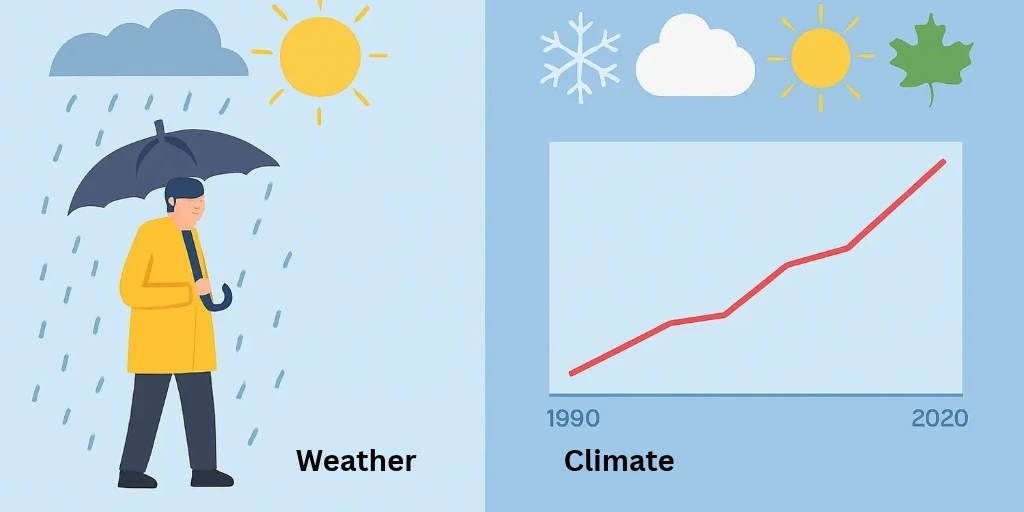
Weather and climate both describe the atmosphere, but they do not mean the same thing. Weather is the condition of the atmosphere at a particular place and time, while climate is the usual pattern of weather in a place over a long period. Understanding this difference helps us interpret daily forecasts, understand seasonal changes, study ecosystems, and think clearly about long-term environmental changes.
Let Us Understand the Concept
What Is Weather?
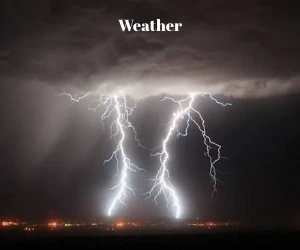
Weather is the short-term state of the atmosphere. It tells us what is happening outside now or what may happen over the next few hours or days. For example, a morning may be sunny, a strong wind may blow in the afternoon, and rain may fall in the evening. All these are changes in weather.
Weather can be described using several atmospheric elements. These include air temperature, rainfall, humidity, wind speed, wind direction, air pressure, cloud cover, and sunshine. A weather report may tell us that the temperature is 30 °C, the wind is moving from the southwest, and there is a high chance of rain. These are observations or predictions about short-term atmospheric conditions.
Why Does Weather Change?
Weather changes because the Sun does not heat every part of Earth equally. The equator receives more direct sunlight than the polar regions. Land and water also heat and cool at different rates. These unequal temperature differences cause differences in air pressure.
Air moves from areas of higher pressure toward areas of lower pressure. This moving air is called wind. When warm air rises, it may cool as it moves upward. Water vapour in the cooling air can condense into tiny water droplets, forming clouds. If the droplets become large and heavy enough, they fall as rain. Therefore, differences in heating, air movement, water vapour, and pressure all help produce changing weather.
Important Elements of Weather
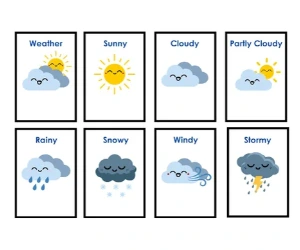
Temperature tells us how hot or cold the air is. It is commonly measured in degrees Celsius (°C). Temperature affects evaporation, cloud formation, living organisms, and human comfort.
Humidity is the amount of water vapour present in the air. Warm air can generally hold more water vapour than cold air. When air becomes nearly full of water vapour, it is described as humid. High humidity can make a day feel hotter because sweat evaporates more slowly from our skin.
Rainfall is precipitation in the form of liquid water falling from clouds. Snow, sleet, and hail are other forms of precipitation, although the form depends on the temperature of the air through which the water falls.
Wind is moving air. Wind is described by its speed and direction. A wind vane can show direction, while an anemometer measures wind speed.
Air pressure is the force exerted by the weight of the air above a surface. Differences in air pressure help drive winds and influence the movement of weather systems.
Cloud cover describes how much of the sky is covered by clouds. Clouds affect the amount of sunlight reaching the ground and can bring precipitation.
What Is Climate?
Climate is the long-term pattern of weather in a particular place or region. It is not based on one hot day, one storm, or one unusually cold week. Scientists study weather observations over many years to identify typical temperatures, rainfall patterns, seasons, winds, and other atmospheric conditions.
Climate describes what conditions are generally expected in a place. For example, a desert climate is usually dry and receives very little rainfall. A tropical climate is generally warm throughout much of the year and may receive considerable rainfall. A polar climate is very cold for most of the year. These descriptions do not mean that every single day is identical. Weather can still change within each climate region.
How Is Climate Studied?
Scientists collect weather information from weather stations, satellites, ships, aircraft, ocean instruments, and other measuring systems. They examine records of temperature, rainfall, winds, humidity, pressure, and other variables over long periods. A climate description may include averages as well as the usual range of variation and the frequency of events such as droughts or heavy rainfall.
Climate averages are commonly calculated over periods of about 30 years or more. A long period is important because weather naturally changes from day to day and from year to year. Studying many years helps scientists distinguish a long-term pattern from a short-term unusual event.
Weather and Climate: The Main Difference
The simplest way to remember the difference is:
- Weather is what the atmosphere is doing now or over a short period.
- Climate is the usual pattern of weather over a long period.
Suppose a city experiences heavy rain today. This is a weather event. It does not automatically mean that the city has a rainy climate. To describe the climate, scientists must examine rainfall patterns over many years. Similarly, one unusually cold day does not disprove a long-term warming trend. A single day is part of weather, whereas a long-term pattern is related to climate.
A Simple Analogy
Think of weather as your clothing on a particular day. You may wear a raincoat today because it is raining, but you may wear light clothing tomorrow if the weather becomes sunny. Climate is more like the collection of clothes normally needed in a place throughout the year. A person living in a cold region usually needs more warm clothing, even though a warm day may occur occasionally.
Factors That Influence Climate
Several factors help determine the climate of a place. Latitude is the distance north or south of the equator. Places near the equator receive more direct sunlight and are generally warmer than places near the poles.
Altitude is the height of a place above sea level. As altitude increases, air temperature generally decreases. This is why mountain tops can be cold even in regions with warm lowlands.
Distance from the sea also affects climate. Water heats and cools more slowly than land. Coastal areas often have smaller temperature differences between summer and winter than inland areas.
Ocean currents move warm or cold water through the oceans and can influence the temperature and moisture of nearby coastal regions. Relief or topography, such as mountains, can force moist air to rise, causing rainfall on one side and drier conditions on the other. Vegetation, soil, and human activities can also affect local atmospheric conditions.
Weather Systems and Climate Patterns
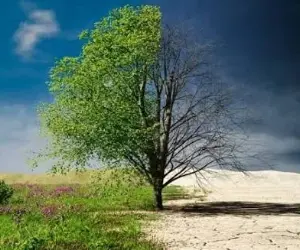
Weather systems may last for hours, days, or sometimes longer. Examples include thunderstorms, heat waves, cold waves, cyclones, and periods of heavy rain. These events are part of weather because they describe conditions over a limited time.
Climate patterns influence the kinds of weather that are more common in a region. For example, a region with a seasonal monsoon climate may receive much of its annual rainfall during particular months. However, the exact beginning, ending, strength, and distribution of rainfall can vary from year to year. The long-term seasonal pattern is climate, while the rainfall on a specific day is weather.
How Weather and Climate Are Connected
Weather and climate are different, but they are connected. Climate influences the conditions in which weather develops. For example, a warm, moist region may commonly experience thunderstorms, while a cold, dry region may more often experience snowfall or clear skies.
At the same time, scientists study many individual weather observations to understand climate. A long record of daily temperatures and rainfall can reveal whether average conditions or the frequency of certain events are changing. In this way, weather observations provide the evidence used to study climate.
Climate Change and Weather Events
Climate change means a long-term change in the average conditions or patterns of the atmosphere, oceans, land, and living systems. It is different from ordinary daily weather variation. Natural factors can influence climate, but human activities such as burning fossil fuels have increased the concentration of heat-trapping greenhouse gases in the atmosphere. These gases contribute to long-term warming of the climate system.
A single storm cannot by itself prove or disprove climate change. However, climate change can influence the background conditions in which some weather events occur. Scientists examine long-term records, physical evidence, and climate models to study these relationships. It is important to distinguish a short-term event from a long-term trend.
Important Scientific Terms and Their Meanings
Temperature: Measure of how hot or cold the air is. Temperature may be recorded in degrees Celsius.
| Scientific Term | Simple Meaning | Example or Explanation | |
|---|---|---|---|
| Weather | Short-term condition of the atmosphere | Rain falling this afternoon is a weather event. | |
| Climate | Long-term pattern of weather in a region | A desert is generally hot and dry over many years. | |
| Humidity | Amount of water vapour in the air | High humidity can make a warm day feel uncomfortable. | |
| Precipitation | Water falling from the atmosphere to Earth | Rain, snow, sleet, and hail are forms of precipitation. | |
| Air Pressure | Force exerted by the weight of air | Pressure differences help produce wind. | |
| Wind | Moving air | Wind moves from areas of higher pressure toward lower pressure. | |
| Latitude | Distance north or south of the equator | Latitude affects how directly sunlight reaches a place. | |
| Altitude | Height above sea level | Temperature usually decreases as altitude increases. | |
| Climate Change | Long-term change in climate patterns | It may involve changes in average temperature or rainfall. |
Examples or Activities
Activity: Compare Daily Weather with a Long-Term Pattern
Aim: To understand the difference between daily weather and climate records.
Materials Required: A notebook, a thermometer if available, a calendar, and reliable weather reports.
Procedure:
- Record the temperature, cloud cover, rainfall, and wind conditions in your area each day for two weeks.
- Note how much these conditions change from one day to another.
- Compare your observations with a reliable long-term climate description of your region.
- Discuss why two weeks of observations cannot completely describe the climate.
Observation: Daily conditions may change considerably. One day may be hot and sunny, while another may be cloudy or rainy.
Explanation: These short-term changes represent weather. Climate requires observations collected over many years so that usual patterns and variations can be identified.
Conclusion: A short record helps us observe weather, but a long record is needed to describe climate.
What Should We Understand from This Topic?
Weather and climate both involve the atmosphere, but their time scales are different. Weather describes immediate or short-term conditions such as today’s temperature, rainfall, wind, or cloud cover. Climate describes the typical pattern of these conditions over many years. Weather changes because of unequal heating, air pressure differences, moisture, and moving air. Climate is influenced by latitude, altitude, distance from the sea, ocean currents, landforms, vegetation, and changes in the atmosphere.
One unusual weather event should not be confused with a climate trend. To understand climate, scientists use long-term records and examine averages, variations, and repeated patterns. This distinction is essential when studying environmental changes and interpreting scientific information.
Key Points to Remember
- Weather is the short-term condition of the atmosphere.
- Climate is the long-term pattern of weather in a place or region.
- Temperature, rainfall, humidity, wind, air pressure, and cloud cover are elements of weather.
- Unequal heating of Earth creates differences in temperature and air pressure.
- Wind is moving air, generally flowing from higher-pressure areas toward lower-pressure areas.
- Climate is studied using weather observations collected over many years.
- Latitude, altitude, distance from the sea, ocean currents, and landforms influence climate.
- A single hot day or storm describes weather, not the complete climate of a region.
- Climate change refers to long-term changes in average conditions or patterns.
- Weather observations help scientists identify and study climate patterns.
Conclusion
Weather tells us what the atmosphere is doing over a short period, while climate tells us what weather is usually like over a long period. Remembering this difference helps us understand forecasts, seasons, environmental records, and climate change more accurately. Weather can change from day to day, but climate is recognised through patterns that appear over many years.