

Recently updated on October 21st, 2026 at 12:49 pm
Competitive exams are not just about knowing formulas — they are about speed, accuracy, and smart thinking. Many students lose marks not because they don’t know math, but because they run out of time. That’s where math tricks and shortcuts play a major role.
But before you dive into shortcuts, remember: even the best tricks work only if your basics are solid. If you’re shaky on fundamentals, spend some time strengthening your foundation — it’s like building a house; without a sturdy base, nothing stands firm. Make sure you thoroughly understand each topic and concept, so you can quickly spot which math trick fits where.
And don’t just memorise formulas. Know when and how to use them, so you can save precious seconds on the exam. A strong grip on the basics and the right application of formulas will help you make the most of these shortcuts and ace those quantitative questions.
In this blog, we’ll explore simple and effective math tricks that can help you solve questions faster and perform better in competitive exams like SSC, Banking, Railway, CAT, GMAT, GRE, and other entrance tests.
1. Multiplication Tricks for Fast Calculations
Trick: Multiply numbers ending with 5
Example: 35 × 35
- Take the first digit (3) × next number (4) = 12
- Add 25 at the end
Answer: 1225
This trick works for all numbers ending with 5 and saves a lot of time.
2. Percentage to Fraction Shortcut
Instead of calculating long percentages, convert them into fractions:
25% = 1/4
50% = 1/2
75% = 3/4
12.5% = 1/8
This trick is very useful in profit & loss, discounts, and data interpretation questions.
3. Squaring Numbers Quickly
Trick: Square numbers near 100
Example: 98²
- Difference from 100 = –2
- 100 – 2 = 98
- Square of 2 = 04
Answer: 9604
This trick works best for numbers close to 100.
Shortcut for Finding Cube Roots
If cube roots sound scary, there’s actually a neat trick for perfect cubes—especially for numbers up to six digits. Here’s how you can solve cube roots in seconds (without turning to your calculator):
How It Works:
Suppose you’re given a number that’s a perfect cube, like 9261 or 32768. You can find its cube root in two quick steps.
Step-by-Step Cube Root Shortcut:
- Step 1: Look at the unit digit
Check the last digit (ones place) of the number. For perfect cubes, the cube root will end with a digit whose cube gives this number.- Example: If the number ends with 1, your cube root will end with 1 (since 1×1×1 = 1).
- If it ends with 8, the cube root ends with 2 (since 2×2×2 = 8), and so on.
- Step 2: Identify the starting digits
Ignore the last three digits of the number. Focus on what remains at the front.- Find the largest cube (from 1³ up to 9³) that’s less than or equal to this leading number.
- The corresponding digit gives you the start of the cube root.
- For 9261, ignoring the last three digits leaves you with 9. The largest cube less than or equal to 9 is 8 (2³), so the first digit is 2.
- Putting it together with your Step 1 answer, the cube root of 9261 is 21.
Try this:
For 32768, the last digit is 8 (so the root ends with 2), and ignoring the last three digits gives 32. The largest cube less than or equal to 32 is 27 (3³), so start with 3. Cube root: 32.
Quick Recap
- The end digit gives you the unit digit.
- Leftover digits point to the starting digit.
- Put them together—that’s your cube root, fast!
Use this whenever you spot a perfect cube in your exam. It’s a favourite of math whizzes and sure to impress in speed rounds!
Quick Square Root Hack
Finding square roots can seem intimidating, but with the right shortcut, you can estimate them faster—no long procedures needed! Here’s a smart way to narrow down the square root of a perfect square:
How it works:
- Look at the last digit:
First, check the units place (last digit) of the number. Ask yourself: which numbers, when squared, end with this digit? For instance, a number ending with 6 could come from both 4² (16) and 6² (36). - Check the first digits:
Next, focus on the first one or two digits (the number’s “front end”). Find the square number closest to—but not exceeding—these digits. For example, with 2116, look at 21. Since 4² = 16 and 5² = 25, you know the root is around 44 or 46. - Test with a quick multiplication:
Multiply your guess (like 44 or 46) by its next consecutive number (44 × 45 or 46 × 47) and see which is closest to your original number’s first digits (here, 21). The closer product points you to the correct square root.
Example 1:
Find √2116
- The last digit is 6: possibilities are 4 or 6.
- The first digits are 21: the closest perfect squares are 16 (4²) and 25 (5²).
- Possible roots: 44 or 46.
- 44 × 45 = 1980; 46 × 47 = 2162 (2162 is closer to 2116), so the answer is 46.
Example 2:
Find √1024
- The last digit is 4: possibilities are 2 or 8.
- The first digits are 10: the closest perfect square is 9 (3²).
- Possible roots: 32 or 38.
- 32 × 33 = 1056 (pretty close to 1024), so the answer is 32.
With a bit of practice, this handy trick saves precious seconds during exams—no calculator required!
4. Time & Speed Smart Method
Instead of solving full equations, use ratio logic.
Example:
- If a train takes 10 seconds to cross a pole, it will take 20 seconds to cross a platform double its length.
- Understanding ratios saves calculation time.
5. Approximation Technique
In exams, exact answers are not always required.
Example: 498 × 203
- Approximate as 500 × 200 = 100000
This helps quickly eliminate wrong options in multiple-choice questions.
6. Vedic Math Basics
Vedic math techniques are very popular in competitive exams because they:
Reduce steps
Improve mental calculation
Increase confidence
Even learning basic Vedic methods can make a big difference.
Identifying Patterns in Number Series
When you’re faced with a tricky number series and aren’t sure which pattern is at play, start by checking the difference between consecutive numbers. This simple move often reveals a hidden formula or sequence.
Let’s look at a quick example:
Suppose you have the series: 46, 62, 87, 123, ?, 236.
Here’s how you can break it down:
- Calculate the Differences: Subtract each number from the one that follows it.
- Spot the Pattern: Once you have the differences, look for familiar numerical patterns—often, you’ll find squares, cubes, multiples, or even a combination.
- In this series, the differences align with perfect squares:
- 62 – 46 = 16 (4²)
- 87 – 62 = 25 (5²)
- 123 – 87 = 36 (6²)
- …and so on.
- In this series, the differences align with perfect squares:
If you’re ever stuck, this approach can help you crack most number series questions. Sometimes, variations in the differences (such as a repeating or multiplying pattern) will point you straight to the answer.
And if you want to dig deeper, explore standard formats like arithmetic, geometric, or mixed-type progressions—knowing a few classic patterns can make all the difference on exam day.
Mixture & Alligation Made Easy
If mixtures and alligation get you scratching your head, there’s a handy trick that makes these questions much less daunting. This technique helps you quickly find the required ratio without wading through complicated equations.
Here’s a simple approach:
- Subtract the mean value from each price (cheaper and dearer).
- Place the absolute differences opposite their respective values.
- The resulting numbers give you the ratio to mix them.
For example:
Let’s say you’re mixing two types of dal: one costs Rs. 50/kg, the other Rs. 75/kg. You want a mixture with an average price of Rs. 65/kg.
- Subtract using the cross-method:
- Difference between Rs. 75 and Rs. 65 = 10
- Difference between Rs. 65 and Rs. 50 = 15
- Place them across:
- Cheaper to dearer: 15: 10
- Simplify: 3: 2
So, mix them in a 3:2 ratio.
This method saves precious time—no fancy formulas required!
Rule of 72: A Quick Doubling Trick
The Rule of 72 is like a cheat code for investors, giving you a lightning-fast way to estimate how long it’ll take your money to double with compound interest—no complicated math required.
Here’s how it works:
- Divide 72 by the annual interest rate.
The result is the number of years it will take for your investment to double.
For example:
If you’re eyeing a savings account with an 8% annual interest rate, just calculate:
72 ÷ 8 = 9 years
So, at 8% interest, your money will double in about nine years—no calculator gymnastics needed. This shortcut is a favourite in competitive exams and even shows up at cocktail parties among finance buffs.
Try it whenever you want a quick estimate, and watch how easily you can out-math your friends!
Why Math Tricks Are Important for Competitive Exams
- Save time
- Improve accuracy
- Reduce exam stress
- Help solve more questions
- Increase overall score
Smart students don’t calculate more — they calculate smarter.
Exam-Wise Math Tricks for Competitive Exams
Different competitive exams focus on different levels of difficulty and question patterns. So, using exam-specific math tricks is the smartest strategy.
Math Tricks for SSC Exams (SSC CGL, CHSL, MTS)
SSC exams are all about speed + basics.
Key Topics
Percentages
Ratio & Proportion
Simple & Compound Interest
Time & Work
Simple Interest & Compound Interest Shortcuts
Let’s face it—questions on Simple Interest (SI) and Compound Interest (CI) can get tricky, but with a couple of quick formulas, you’ll breeze right through.
Quick Formula: Difference Between CI and SI for 2 Years
If you’re asked the difference between simple and compound interest for 2 years on the same sum at the same rate (compounded annually), use:
- Difference = Principal × (Rate/100)²
Shortcut Example:
Suppose you’re told the difference between CI and SI for 2 years at 4% per annum is ₹800.
Let’s find the original sum (P):
- Plug into the shortcut:
800 = P × (4/100) × (4/100)
800 = P × (16/10,000) - Rearranging:
P = 800 × (10,000/16) = ₹50,000
Easy! No long calculations needed.
Key Takeaways:
- For 2 years, just square the rate (as a percentage), multiply by the principal, and you’ve got the difference between CI and SI.
- For 3 years or higher, the formula gets a bit longer, but you rarely need it—most exams stick to 2 years.
This hack is a real lifesaver, especially when time is running short.
Compound Interest: Key Shortcuts & Formulas
Compound interest questions can eat up precious exam time—but only if you let them! Here are some nifty tricks and formulas to help you breeze through these problems without getting bogged down by complex calculations.
1. Net Effective Rate for Multiple Periods
When the interest rate changes over two equal intervals, you don’t need to calculate each period step by step. Instead, use this direct formula:
Effective Rate = x% + y% + (x% × y%)/100
- x = rate in the first interval
- y = rate in the second interval
Perfect for quick comparisons when rates shift mid-problem.
2. Relating Principal and Amounts After Intervals
If you know the principal becomes A₁ after a certain period and A₂ after double that time at the same compound rate, there’s a quick relationship:
P / A₁ = A₁ / A₂
This shortcut avoids lengthy stepwise compound calculations.
3. Finding the Rate Without Direct Calculation
Suppose you know a principal turns into A₁ after T years and A₂ after T+1 years. Use this formula to find the annual rate:
Rate (%) = [(A₂ – A₁) / A₁] × 100
Super handy if you’re given consecutive year amounts.
Example in Action: Quarterly Compounding
Let’s apply these techniques:
If money is compounded quarterly at 16% per annum, each quarter’s rate is 16% ÷ 4 = 4%. To find the net effect over multiple quarters:
- For two quarters:
Effective rate = 4% + 4% + (4 × 4)/100 = 8.16% - For the year (four quarters):
Combine the result for two quarters twice: 8.16% + 8.16% = 16.32%
With these time-saving tricks, compound interest can become one of the easiest chapters to score in.
Useful SSC Math Tricks
1. Percentage Comparison Trick
Instead of calculating exact values, compare directly.
Example:
Which is bigger – 35% of 240 or 40% of 200?
- 35 × 240 = 8400
- 40 × 200 = 8000
35% of 240 is bigger
2. Ratio Shortcut
If A : B = 3 : 5 and total = 160
- Total parts = 8
- A = (3/8) × 160 = 60
- B = 100
No long steps required.
Math Tricks for Banking Exams (IBPS, SBI, RRB)

Banking exams test accuracy + calculation speed.
Key Topics
Simplification
Approximation
Data Interpretation
Percentages
Useful Banking Math Tricks
1. Approximation First Rule
Always approximate before solving.
Example:
398 × 51
- 400 × 50 = 20,000
Use this to eliminate wrong options quickly.
2. Fraction to Percentage Trick
1/2 = 50%
1/4 = 25%
1/5 = 20%
1/8 = 12.5%
Very useful in DI and interest problems.
Math Tricks for CAT Exam
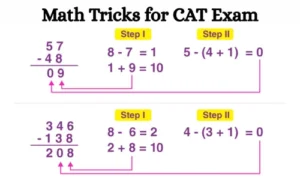
CAT focuses on logic, concept clarity, and smart shortcuts — not speed alone.
Key Topics
Arithmetic
Geometry
Number Systems
Useful CAT Math Tricks
1. Option Elimination Technique
Instead of solving fully, test options.
Example:
If x² – 5x + 6 = 0
- Try x = 2 → works
- Try x = 3 → works
No need for full factorisation.
2. Averages Shortcut
If the average of 5 numbers is 20
- Total = 5 × 20 = 100
CAT questions often hide this simple logic.
Math Tricks for GMAT / GRE
These exams focus on conceptual understanding + smart math.
Key Topics
Arithmetic
Word Problems
Algebra
Useful GMAT/GRE Math Tricks
1. Back-Calculation Method
Use answer choices to reach the question.
This saves time and reduces calculation errors.
2. Units Digit Trick
Find only the last digit instead of the full calculation.
Example:
7²³ → Units digit repeats every 4
7¹ = 7
7² = 9
7³ = 3
7⁴ = 1
7²³ → remainder 3 → units digit = 3
Math Tricks for Railway Exams

Railway exams emphasise speed and basic math.
Key Topics
Speed, Time & Distance
Percentages
Time & Work
Useful Railway Math Tricks
1. Speed Conversion Trick
km/hr to m/s → multiply by 5/18
Example:
54 km/hr
- 54 × 5/18 = 15 m/s
2. Simple Time & Work Trick
If A does work in 10 days, B in 20 days
- A + B = 1/10 + 1/20 = 3/20
- Work completed in 6⅔ days
How to Use These Math Tricks Effectively
- Practice exam-wise
- Use tricks only after understanding concepts
- Apply them in mock tests
- Avoid over-memorising
- Focus on accuracy first, then speed
Practice and Visualisation: The Real Shortcuts
The secret sauce behind mastering these math tricks? Practice—and then a bit more practice. The more problems you tackle, the more natural shortcuts become. Over time, your brain starts recognising patterns instantly, which slashes the time spent per question.
When a problem looks too bulky or tangled, don’t hesitate to break it down visually. Sketching tables or simple charts (yes, even rough ones on your scratch paper) can help organise messy data, expose hidden patterns, and prevent silly calculation errors. This is especially effective for data-heavy questions, whether you’re dealing with percentage distributions, ratios, or multi-step arithmetic.
Think of it as building your own cheat sheet during the exam—one that turns chaos into clarity at a glance.
Conclusion
Math doesn’t have to be scary. With the right tricks and smart shortcuts, you can solve questions faster and score higher in competitive exams. Start practising these math tricks today and make math your strongest subject.
There is no single math trick for all exams. Each competitive exam demands its own smart strategy. By learning and applying exam-specific math shortcuts, students can save time, reduce stress, and significantly improve their scores.