
The global carbon cycle is the continuous movement of carbon between the atmosphere, living organisms, soil, oceans, rocks, and fossil fuels. Carbon is an essential element because it forms carbohydrates, proteins, fats, DNA, and many other substances found in living organisms. It is also present in carbon dioxide, methane, limestone, coal, petroleum, and natural gas.
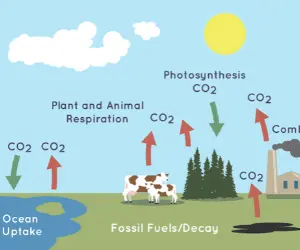
Carbon does not stay permanently in one place. Plants remove carbon dioxide from the air during photosynthesis, animals obtain carbon by feeding on plants or other animals, and carbon returns to the environment through respiration, decomposition, and combustion. Understanding this cycle helps us explain how ecosystems function and why burning fossil fuels can affect Earth’s climate.
Let Us Understand the Concept
What is carbon?
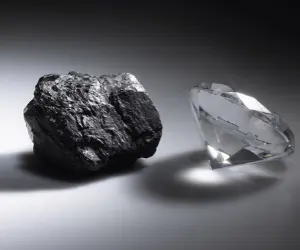
Carbon is a chemical element represented by the symbol C. It can combine with many other elements and form a very large number of compounds. All known living organisms contain carbon, which is why carbon is often called the basic chemical element of life.
In the environment, carbon occurs in several forms. The atmosphere contains carbon mainly as carbon dioxide, CO2, and a smaller amount as methane, CH4. Plants store carbon in their leaves, stems, roots, and fruits. Animals store it in their bodies. Soil contains carbon in dead organic matter, while oceans contain dissolved carbon dioxide, bicarbonate, and carbonate ions. Rocks such as limestone store carbon for very long periods.
What is the carbon cycle?
The carbon cycle is the natural circulation of carbon among Earth’s major reservoirs. A reservoir is a place where carbon is stored. Important carbon reservoirs include the atmosphere, plants, animals, soil, oceans, sediments, rocks, and fossil fuels.
The movement of carbon from one reservoir to another is called a carbon flux. For example, when a plant absorbs carbon dioxide from the atmosphere, carbon moves from the atmosphere into the plant. When the plant dies and decomposes, some of that carbon moves into the soil and some returns to the atmosphere as carbon dioxide.
The carbon cycle is not a single circular path with only one direction. It is a network of connected processes. Some movements happen quickly, while others take thousands or millions of years.
Step 1: Photosynthesis removes carbon dioxide from the atmosphere
Green plants, algae, and some microorganisms use sunlight to make food through photosynthesis. During this process, they take in carbon dioxide from the air or water and combine it with water to produce glucose and oxygen.
The simplified equation is:
6CO2 + 6H2O → C6H12O6 + 6O2
Light energy is required for this reaction. The carbon from carbon dioxide becomes part of the glucose and is later used to make plant tissues such as wood, leaves, roots, and seeds. In this way, photosynthesis transfers carbon from the atmosphere into living matter.
For example, a young tree absorbs carbon dioxide as it grows. Some of the carbon becomes part of its trunk and branches. A forest therefore acts as a carbon store, although the stored carbon can return to the atmosphere if plants are burned or decomposed.
Step 2: Carbon moves through food chains
Animals cannot usually take carbon dioxide directly from the atmosphere to make food. Instead, they obtain carbon by eating plants or by eating other animals. A grass plant stores carbon in its tissues, a grasshopper obtains some of that carbon by feeding on the grass, and a frog may obtain it by eating the grasshopper.
In this way, carbon moves through food chains and food webs. Not all the carbon in food becomes part of an animal’s body. Some is used to release energy, and some leaves the body as waste.
Step 3: Respiration returns carbon dioxide to the environment
Cellular respiration is the process by which cells release usable energy from food. Plants, animals, fungi, and many microorganisms carry out respiration. During aerobic respiration, glucose reacts with oxygen and produces carbon dioxide, water, and energy.
The simplified equation is:
C6H12O6 + 6O2 → 6CO2 + 6H2O + energy
The carbon dioxide produced during respiration can enter the atmosphere or dissolve in water. Plants also respire, even though they remove carbon dioxide during photosynthesis. During daylight, photosynthesis may remove more carbon dioxide than the plant releases, but respiration continues both day and night.
Step 4: Decomposition transfers carbon from dead matter
When plants and animals die, their bodies contain carbon-rich compounds. Decomposers, such as bacteria and fungi, break down this dead organic matter. They use some of the carbon for their own growth and release carbon dioxide during respiration.
In places without oxygen, such as waterlogged soils, wetlands, and the stomachs of some animals, certain microorganisms may produce methane instead of releasing only carbon dioxide. Methane is also a carbon-containing greenhouse gas. Decomposition may therefore return carbon to the atmosphere as carbon dioxide or methane, while some carbon remains in the soil as organic matter.
Step 5: Combustion releases stored carbon
Combustion means burning. When wood, dry leaves, coal, petroleum, natural gas, or other carbon-containing materials burn in the presence of oxygen, the carbon is mainly converted into carbon dioxide.
For example, the carbon stored in a piece of firewood came from carbon dioxide absorbed by a tree during photosynthesis. Burning the wood returns much of that carbon to the atmosphere. Burning fossil fuels has a similar effect, but fossil fuels contain carbon that was stored underground for millions of years.
Incomplete combustion can also produce carbon monoxide and soot. These products can later be changed or transported through the environment, but complete combustion mainly produces carbon dioxide and water.
Step 6: Carbon moves between the atmosphere and oceans
Oceans are one of Earth’s largest active carbon reservoirs. Carbon dioxide from the atmosphere dissolves in seawater. Marine plants and algae use dissolved carbon dioxide for photosynthesis. Carbon then moves through marine food webs when animals eat these organisms.
Some carbon returns to the water or atmosphere through respiration and decomposition. Some sinks as dead organisms, shells, and organic particles. Shell-forming organisms use carbonate substances to make shells and skeletons. Over long periods, these materials may become part of seafloor sediments and carbonate rocks.
The exchange between air and ocean works in both directions. When seawater absorbs more carbon dioxide, ocean chemistry changes, and seawater becomes more acidic. This does not mean that the ocean becomes a strong acid, but its pH decreases. Lower pH can make it more difficult for some organisms to build shells and skeletons from calcium carbonate.
Step 7: The slow geological carbon cycle
The fast carbon cycle involves processes that usually occur over days, years, or centuries. Photosynthesis, feeding, respiration, decomposition, and fire are important parts of this cycle.
The slow carbon cycle operates over thousands to millions of years. Carbon dioxide can dissolve in rainwater, which becomes mildly acidic as it moves through soil and rocks. This water can slowly weather rocks and carry dissolved carbon compounds into rivers and oceans. Some carbon is deposited as sediments and eventually becomes carbonate rock.
Heat and pressure deep inside Earth can transform buried organic matter into fossil fuels. Geological activity, including volcanic eruptions and the movement of tectonic plates, can return some stored carbon to the atmosphere. The slow cycle helps regulate Earth’s carbon balance over very long time periods.
Natural carbon sinks and sources
A carbon sink absorbs and stores more carbon than it releases over a particular period. Forests, soils, oceans, wetlands, and growing vegetation can act as carbon sinks. A sink is not necessarily permanent; for example, a forest may release stored carbon if it burns or is cleared.
A carbon source releases more carbon than it absorbs during a particular period. Wildfires, decomposition, volcanic activity, and the burning of fossil fuels can act as carbon sources. A reservoir can change from a sink to a source when environmental conditions change.
How human activities affect the carbon cycle
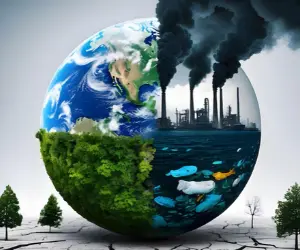
Human activities do not create carbon, but they can move large amounts of stored carbon into the atmosphere more quickly than many natural processes can remove it. The largest human influence is the burning of coal, petroleum, and natural gas for electricity, transport, heating, and industry. This transfers geological carbon into atmospheric carbon dioxide.
Deforestation also affects the cycle. When forests are cut or burned, carbon stored in vegetation is released, and fewer trees remain to absorb carbon dioxide through photosynthesis. Disturbing soil can release some of its stored carbon as well.
Extra atmospheric carbon dioxide strengthens the greenhouse effect. Greenhouse gases absorb and re-emit some outgoing infrared radiation, causing the atmosphere and Earth’s surface to retain more heat than they otherwise would. This contributes to global warming and climate change. The oceans and land ecosystems absorb part of the extra carbon dioxide, but this absorption does not remove all of it or prevent all environmental effects.
Actions such as protecting forests, restoring wetlands, improving soil management, reducing fossil-fuel use, using energy efficiently, and developing low-carbon energy sources can help reduce the disturbance of the carbon cycle. These actions work best when they reduce emissions as well as protect natural carbon stores.
Important Scientific Terms and Their Meanings
Carbon reservoirA place where carbon is stored.
| Scientific Term | Simple Meaning | Example or Explanation |
|---|---|---|
| Carbon cycle | The movement of carbon through Earth’s atmosphere, organisms, oceans, soil, and rocks. | Photosynthesis and respiration are parts of the carbon cycle. |
| Forests, oceans, rocks, and fossil fuels are reservoirs. | ||
| Carbon flux | The movement of carbon from one reservoir to another. | Photosynthesis moves carbon from the atmosphere into plants. |
| Photosynthesis | The process by which green organisms use light to make food from carbon dioxide and water. | Plants use photosynthesis to store carbon in glucose and plant tissues. |
| Respiration | A cellular process that releases energy from food. | Respiration releases carbon dioxide when glucose is broken down. |
| Decomposer | An organism that breaks down dead matter and waste. | Fungi and bacteria are important decomposers. |
| Combustion | Burning a substance in the presence of oxygen. | Burning wood or petrol releases carbon dioxide. |
| Carbon sink | A system that absorbs and stores more carbon than it releases for a period. | A growing forest can act as a carbon sink. |
| Carbon source | A system or activity that releases more carbon than it absorbs for a period. | Fossil-fuel combustion is a major carbon source. |
| Greenhouse gas | A gas that absorbs and re-emits heat radiation in the atmosphere. | Carbon dioxide and methane are greenhouse gases. |
Examples or Activities
Example: Following one carbon atom
Imagine that a carbon atom is present in atmospheric carbon dioxide. A plant absorbs it during photosynthesis and uses it to make a sugar molecule. A caterpillar eats part of the leaf, so the carbon enters the caterpillar’s body. A bird eats the caterpillar, and the carbon moves into the bird. When the bird respires, some of the carbon returns to the atmosphere as carbon dioxide. When the bird dies, decomposers break down its remains and return more carbon to the soil and atmosphere.
This example shows that the carbon cycle connects living organisms with the non-living environment.
Safe observation activity: Comparing carbon stores
Aim: To identify common materials that store carbon.
Materials Required: A leaf, a small piece of wood, a little soil, a shell or limestone pebble if available, and a notebook.
Procedure:
- Observe each material without damaging it.
- Record whether it came from a living organism, dead organic matter, or a geological material.
- For each item, write one process that could move its carbon to another reservoir.
Observation: Leaves and wood are biological carbon stores, soil contains organic carbon, and shells or limestone store carbon in mineral form.
Explanation: Carbon occurs in both living and non-living parts of the environment. Decomposition, combustion, weathering, and sediment formation can transfer it between these stores.
Conclusion: Carbon is distributed through many reservoirs, not just the atmosphere.
What Should We Understand from This Topic?
The global carbon cycle is a connected system in which carbon constantly moves between the atmosphere, living organisms, soil, oceans, rocks, and fossil fuels. Photosynthesis removes carbon dioxide from the atmosphere and stores carbon in plants. Feeding transfers carbon through food webs, while respiration and decomposition return carbon to the environment. Fire and fossil-fuel combustion can release stored carbon rapidly.
The fast carbon cycle operates over relatively short periods, whereas the slow geological cycle operates over thousands or millions of years. Human activities, especially fossil-fuel burning and deforestation, have increased the speed at which long-stored carbon enters the atmosphere. This changes the balance of the carbon cycle and contributes to climate change and ocean acidification.
Key Points to Remember
- Carbon is an essential element found in all known living organisms.
- The carbon cycle is the movement of carbon among the atmosphere, organisms, soil, oceans, rocks, and fossil fuels.
- Photosynthesis transfers carbon dioxide from the atmosphere into plants.
- Carbon moves through food chains when organisms eat plants or other organisms.
- Respiration returns carbon dioxide to the atmosphere or water.
- Decomposers return carbon from dead matter to soil, water, and the atmosphere.
- Combustion releases carbon dioxide from wood and fossil fuels.
- Oceans absorb, store, and release carbon, but extra carbon dioxide can change ocean chemistry.
- The fast carbon cycle acts over days to centuries, while the slow cycle acts over thousands to millions of years.
- Forests, soils, wetlands, and oceans can act as carbon sinks.
- Fossil-fuel burning and deforestation increase the amount of carbon dioxide in the atmosphere.
Conclusion
The global carbon cycle keeps carbon moving through Earth’s living and non-living systems. Natural processes maintain a balance among different carbon reservoirs, but human activities can disturb this balance by releasing long-stored carbon rapidly. Learning how photosynthesis, respiration, decomposition, ocean exchange, and combustion are connected helps us understand ecosystems, climate change, and the importance of protecting natural carbon sinks.