
Recently updated on January 9th, 2026 at 05:53 am
Have you ever dropped a pen and noticed how it always falls down?
Why not sideways?
Why not upward?
This simple question has puzzled humans for thousands of years. For Students, understanding why objects fall is not just about science—it’s about learning how the universe behaves around us.
Let’s explore gravity in a clear, simple, and interesting way—without formulas or complicated words.
Also See: What Is Physics?
The Everyday Mystery We Never Question

Every day, objects fall:
A book slips from your hand.
Rain falls from the sky.
A mango drops from a tree.
We see this so often that we stop questioning it. But the real question is:
What is pulling everything downward?
The answer lies in an invisible force that works silently, all the time.
The Invisible Pull Called Gravity
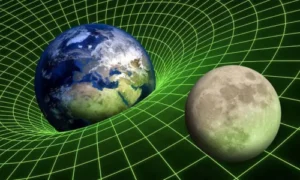
Gravity is a natural pull that exists between objects that have mass.
The Earth is extremely massive.
Because of that, it pulls everything toward its centre.
This pull is what makes objects fall when you drop them.
You cannot see gravity.
You cannot hear it.
But you can always feel its effect.
When you jump, gravity brings you back down.
When you throw a ball up, gravity pulls it back.
Why Don’t Objects Float Instead?

If gravity did not exist, objects would float around freely.
Astronauts in space float because they are far from Earth’s strong pull.
On Earth, the pull is strong enough to keep everything grounded.
Even the air around us stays close to Earth because of gravity.
Without gravity:
People would float away
Water would escape into space
Life would not exist as we know it
Gravity is what keeps the planet stable and livable.
What Makes Earth’s Gravity So Strong?
The strength of gravity depends on mass.
Earth is huge.
It contains oceans, mountains, rocks, and molten metal inside.
Because of this enormous mass, its gravitational pull is very strong.
Small objects like pens or books also have gravity, but their pull is too weak for us to notice.
That’s why:
Earth pulls the pen
The pen does not pull Earth toward it
The Scientist Who Asked the Right Question

Hundreds of years ago, a scientist wondered the same thing students ask today.
Why does an apple fall straight down?
This curiosity led Isaac Newton to study gravity deeply.
He did not invent gravity.
He explained how it works.
Newton realised that the same force pulling an apple down also controls the motion of the Moon and planets.
This idea changed science forever.
Do Heavier Objects Fall Faster?

Many students believe heavier objects fall faster than lighter ones.
But here’s the surprise:
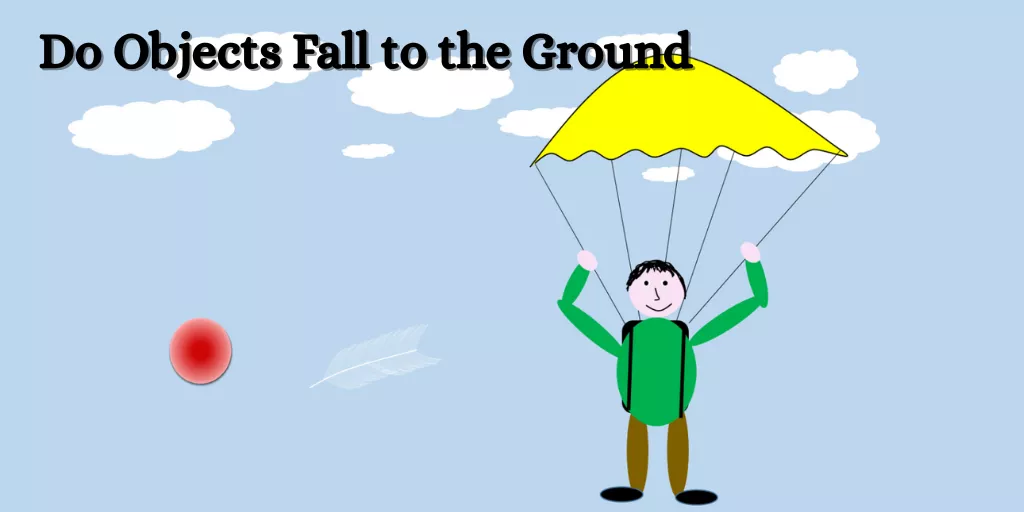
If air resistance is ignored, all objects fall at the same speed.
A stone and a feather fall differently on Earth because air slows the feather down.
In places without air, they fall together.
So it’s not weight—it’s air that makes the difference.
Why Don’t Birds Fall from the Sky?

Birds fall too—just not straight down.
They use their wings to push air downward.
This creates an upward force that balances gravity.
Aeroplanes do the same thing with their wings.
Gravity is still pulling them down, but lift helps them stay up.
Once the wings stop working, gravity takes over.
Gravity Is Not Just an Earth Thing
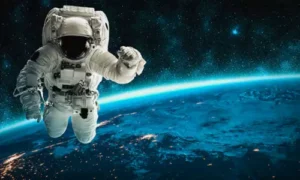
Gravity exists everywhere in the universe.
The Moon stays in orbit because Earth pulls it.
Planets orbit the Sun because of gravity.
Stars form because gravity pulls gas together.
Without gravity:
There would be no planets
No stars
No solar systems
Gravity shapes the entire universe.
Why Gravity Is Important for Students to Understand
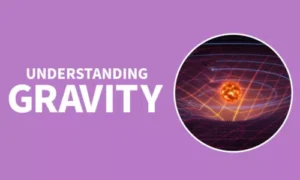
Gravity is not just a science chapter.
It explains:
Why do we walk instead of float
Why rivers flow downward
Why do objects have weight
Understanding gravity helps students connect science with daily life.
It also builds curiosity—an essential habit for learning.
A Simple Way to Remember Gravity
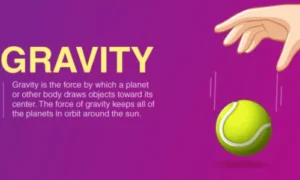
If you ever forget what gravity does, remember this:
If something can fall, gravity is the reason.
From a falling leaf to a jumping child—gravity is always working quietly in the background.
Simple Physics examples from daily life
1. Why a Ball Falls to the Ground
When you throw a ball up, it comes back down instead of floating away.
This happens because of gravity, the force that pulls objects toward the Earth.
Daily life link:
Dropping a pen, jumping, rain falling.
2. Why We Slip on a Wet Floor
It is harder to walk on a wet floor because the friction becomes very small.
Friction is the force that helps us grip the ground while walking.
Daily life link:
Slipping in bathrooms, roads becoming slippery in the rain.
3. Why We Feel Cool Under a Fan
A fan does not reduce temperature, but it moves air faster.
Fast-moving air increases evaporation of sweat from our skin, making us feel cool.
Daily life link:
Using a fan after playing, drying wet clothes faster in the wind.
4. Why a Bicycle Stops When You Stop Pedalling
When you stop pedalling, the bicycle slowly comes to rest.
This happens because of friction and air resistance acting against motion.
Daily life link:
Cycling, rolling a ball on the ground.
5. Why We Hear an Echo
When sound hits a wall or hill, it reflects and comes back to our ears.
This reflected sound is called an echo.
Daily life link:
Shouting near a building, speaking in an empty hall.
Conclusion
The next time you drop something, don’t ignore it.
Ask yourself:
Why did it fall?
That simple question is where science begins.
Frequently Asked Questions (FAQ)
1. Why do objects always fall downward?
Objects fall downward because the Earth pulls them toward its centre. This pulling force is called gravity, and it acts on all objects near Earth.
2. Does gravity work on all objects?
Yes. Gravity works on everything that has mass—big or small. It pulls people, books, water, air, and even mountains toward the Earth.
3. Who discovered gravity?
Gravity was explained by Sir Isaac Newton. He observed falling objects and understood that the same force pulling things down also controls the motion of the Moon and planets.
4. Do heavier objects fall faster than lighter ones?
No. If there is no air resistance, heavy and light objects fall at the same speed. On Earth, air slows down lighter objects like feathers.
5. Why don’t we feel gravity all the time?
We don’t feel gravity directly because it is always acting on us in the same way. We notice it only when we jump, fall, or lift something heavy.
6. Why don’t birds and aeroplanes fall to the ground?
Birds and aeroplanes create an upward force using their wings. This force balances gravity and helps them stay in the air.
7. Is gravity only present on Earth?
No. Gravity exists everywhere in the universe. It keeps planets in orbit, holds stars together, and controls the motion of galaxies.
8. What would happen if gravity suddenly disappeared?
If gravity stopped, everything would float away. People, water, air, and even buildings would leave the Earth, making life impossible.