

Recently updated on January 5th, 2026 at 09:35 am
STEM education is a modern learning approach that focuses on Science, Technology, Engineering, and Mathematics. For young learners, STEM is not about complex formulas or coding. Instead, it encourages curiosity, creativity, and problem-solving through fun, hands-on activities.
Children naturally ask questions like “Why does this happen?” or “How does this work?” STEM education builds on this curiosity and helps children explore the world around them logically and engagingly.
1. What Does STEM Stand For?

STEM includes four key learning areas:
- Science – Understanding nature, plants, animals, space, and everyday phenomena
- Technology – Learning how tools, machines, and digital systems work
- Engineering – Building, designing, and solving real-life problems
- Mathematics – Numbers, patterns, measurements, and logical thinking
Together, these subjects help children think critically and creatively.
2. Why Is STEM Important for Young Learners?
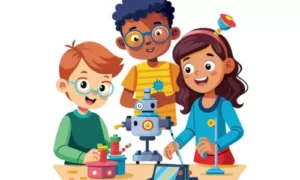
Early childhood is the best time to develop thinking skills. STEM education helps children:
1. Ask questions and find answers
2. Learn by doing instead of memorising
3. Develop problem-solving skills
4. Improve creativity and imagination
5. Gain confidence in learning
When STEM learning starts early, children become more comfortable with challenges and learn not to fear mistakes.
3. How STEM Learning Works for Children

STEM education for young learners focuses on play-based and activity-based learning. Examples include:
- Mixing colours to understand science
- Building blocks to learn engineering concepts
- Counting toys to improve math skills
- Simple experiments using household items
These activities make learning enjoyable and meaningful.
STEM Education vs Traditional Learning
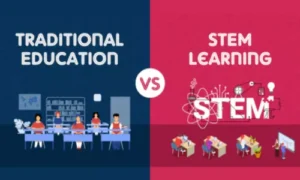
Traditional learning often focuses on textbooks and memorisation. STEM education focuses on:
| Traditional Learning | STEM Learning |
|---|---|
| Memorization | Understanding concepts |
| Passive listening | Active participation |
| Fixed answers | Creative solutions |
| Exams-focused | Skill-focused |
STEM prepares children for real-world thinking, not just exams.
4. Role of Parents in STEM Learning

Parents play an important role in early STEM education. You don’t need to be a teacher or expert. Simple actions help:
- Encourage children to ask questions
- Allow them to experiment and explore
- Support curiosity instead of giving direct answers
- Provide everyday learning experiences
STEM learning can happen at home, in parks, or even during daily routines.
Conclusion
STEM education for young learners builds a strong foundation for lifelong learning. It helps children become thinkers, problem-solvers, and innovators. Starting STEM early gives children the confidence to explore, learn, and thrive in a rapidly changing world.
FAQ – QUESTIONS & ANSWERS
1. What is STEM education in simple words?
STEM education teaches children science, technology, engineering, and math through fun activities and real-life examples.
2. At what age can STEM education start?
STEM learning can start as early as 3 years old, using play-based and simple activities.
3. Is STEM education difficult for young children?
No. STEM for young learners is designed to be simple, engaging, and age-appropriate.
4. Can parents teach STEM at home?
Yes. Parents can support STEM learning by incorporating daily activities, engaging toys, and simple experiments into their routine.
5. Why is STEM important for a child’s future?
STEM builds critical thinking, creativity, and problem-solving skills needed for future careers and life.