
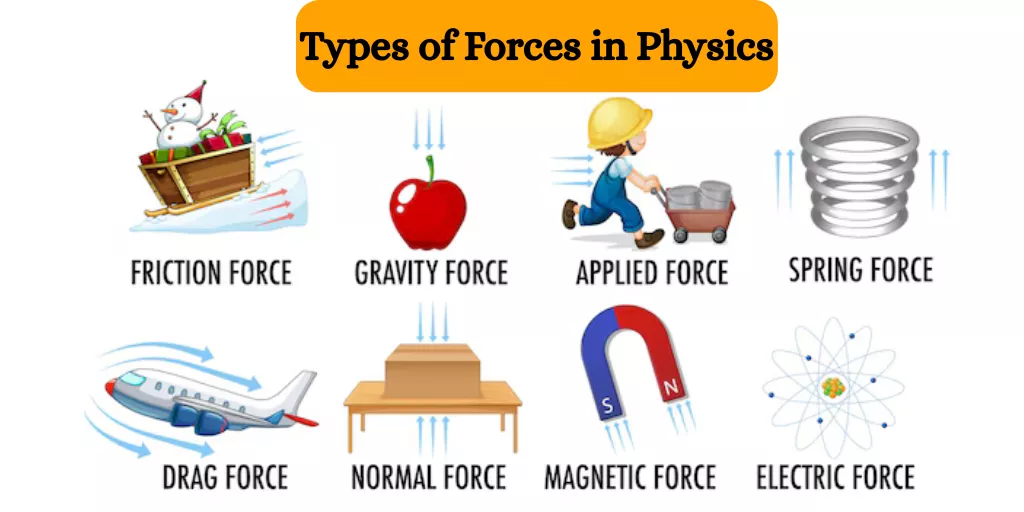
When you push a door, kick a ball, or pull a bag, you are using a force. ( forces in physics)
Force is something we use every day, even without thinking about it.
This article is written for students in simple English to help you clearly understand:
What force means
Different types of forces in physics
Contact and non-contact forces
Examples you see in daily life
This topic is very important for school exams, especially for classes 6 to 9.
Also See: Force and Its Effects
What Is a Force?
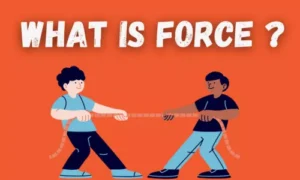
A force is a push or a pull.
A force can:
Move an object
Stop a moving object
Change the direction of motion
Change the shape of an object
Daily examples:
Pushing a chair
Pulling a drawer
Kicking a football
Stretching a rubber band
All these actions involve force.
Why Do We Study Types of Forces?

There are different kinds of forces acting around us.
Some forces need touch, while others act without touching.
To make learning easy, forces are mainly divided into:
Contact forces
Non-contact forces
Understanding this classification helps students:
Answer exam questions correctly
Understand real-life situations
Build a strong base for future science topics
Main Classification of Forces
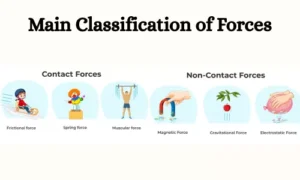
1. Contact Forces
Forces that act only when objects touch each other.
2. Non-Contact Forces
Forces that act without touching the object.
Let us understand each type clearly with examples.
1. Contact Forces (Force with Touch)
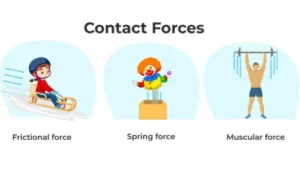
Contact forces work only when two objects are in physical contact.
Common contact forces students must know:
Muscular force
Frictional force
1. Muscular Force
Muscular force is the force applied by human or animal muscles.
We use muscular force in most of our daily activities.
Daily life examples:
Lifting a school bag
Writing with a pen
Opening a bottle
Kicking a ball
Muscular force can be used to:
Push objects
Pull objects
Lift objects
This force needs contact, so it is a contact force.
2. Frictional Force
Friction is a force that opposes motion between two surfaces in contact.
When one surface moves over another, friction acts.
Daily life examples students see:
Walking without slipping
A bicycle slows down when the brakes are applied
Rubbing hands to feel warmth
Erasing pencil marks
Friction can be:
Helpful (walking, writing)
Harmful (wear and tear of machines)
Friction always acts between touching surfaces, so it is a contact force.
2. Non-Contact Forces (Force without Touch)
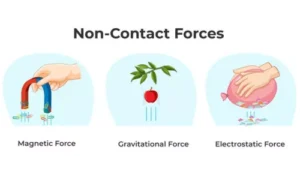
Non-contact forces act even when objects are not touching each other.
This concept often surprises students, but it is easy to understand with examples.
Important non-contact forces:
Gravitational force
Magnetic force
Electrostatic force
1. Gravitational Force
Gravitational force is the force by which the Earth pulls objects towards itself.
Because of gravity:
Objects fall down
We stay on the ground
Rain falls to Earth
Daily life examples:
A book falling from a table
A ball thrown up is coming back down
Jumping and landing on the ground
Gravity acts without contact, so it is a non-contact force.
2. Magnetic Force
Magnetic force is the force exerted by a magnet.
Magnets can:
Attract certain objects
Repel other magnets
Daily life examples:
A magnet sticking to a refrigerator
Magnetic compass pointing north
Magnetic clasps in bags
Magnetic force acts even when the magnet does not touch the object.
3. Electrostatic Force
Electrostatic force is the force caused by electric charges.
This force is usually seen when objects are rubbed.
Daily life examples:
A balloon stuck to a wall
Hair standing after combing
Small paper pieces are attracted to a plastic scale
No touching is required, so it is a non-contact force.
Comparison Table: Contact vs Non-Contact Forces
| Feature | Contact Forces | Non-Contact Forces |
|---|---|---|
| Need physical touch | Yes | No |
| Act from a distance | No | Yes |
| Examples | Muscular, Friction | Gravity, Magnetic, Electrostatic |
| Seen in daily life | Very common | Common but less visible |
| Easy to observe | Yes | Sometimes |
Forces Students See Daily
Here are examples students have every day:
Walking → friction + muscular force
Writing → muscular force + friction
Falling object → gravitational force
Magnet on fridge → magnetic force
Balloon on wall → electrostatic force
These examples help students connect physics to real-life situations.
Why This Topic Is Important for Exams

Teachers often ask questions from this chapter because:
It tests basic understanding
It connects science to daily life
It prepares students for higher classes
Common exam questions:
1. Define force
2. Name types of forces
3. Differentiate contact and non-contact forces
4. Give two examples of each force
Simple Way to Remember
Easy Memory Trick
Contact force → Touch needed
Non-contact force → No touch needed
Or remember:
“If it touches, it is contact.
If it acts from far, it is non-contact.”
Final Summary for Students
Force means push or pull
Forces are of different types
Contact forces need touch
Non-contact forces do not need touch
Examples help us understand better
This chapter is very important for exams