

The Sun is the centre of our solar system, providing the primary source of light and energy for life on Earth. Plants cannot grow without the Sun, climates collapse, and life as we know it does not exist. Let’s look at some critical and fun Sun facts that every student should know. The Sun is at the centre of the solar system and gives us light and heat. Without it, plants cannot grow, and life on Earth cannot survive. Below are some easy and fun Sun facts for students to learn.
What Is the Sun?
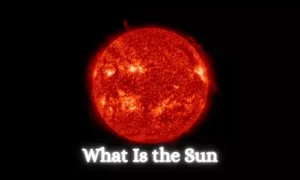
- The Sun is a star, not a planet.
- It is primarily composed of hot gases, such as hydrogen and helium.
- The Sun stays in one place while planets revolve around it due to gravity.
Key Facts About the Sun

- Age: About 4.6 billion years old
- Distance from Earth: Around 150 million kilometres
- Shape: Almost perfectly round
Temperature:
- Surface: ~5,500°C
- Core: ~15 million°C
Why Is the Sun Important?
The Sun plays a vital role in our daily lives:
- Provides light and heat
- Helps plants make food through photosynthesis
- Controls weather and climate
- Keeps planets in their orbits with gravity
- Supports the water cycle (evaporation → rain)
Layers of the Sun (Easy to Remember)
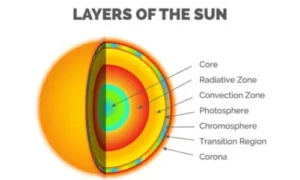
- Core – Where nuclear reactions happen
- Radiative Zone – Energy moves outward
- Convective Zone – Hot gases rise and fall
- Photosphere – Visible surface
- Chromosphere – Thin reddish layer
- Corona – Outermost glowing layer
Fun and Amazing Sun Facts
- The Sun is so massive that more than one million Earths can fit inside it.
- Sunlight takes around 8 minutes to reach Earth.
- The Sun produces energy by converting hydrogen into helium.
- Looking straight at the sun can cause lasting eye damage.
- The Sun will continue to shine for approximately 5 billion more years.
The Sun and Time

- The Sun rises and sets, causing day and night.
- Seasons are caused by the Earth’s movement around the sun.
- Ancient humans used sundials to measure the passage of time.
Sun Safety Tip for Students
- Never look straight at the sun without protection.
- Do not view solar eclipses with your bare eyes.
- When observing the Sun, use certified sunglasses.
Sun Facts – MCQs & Exam Questions for Students
Multiple Choice Questions (MCQs)
1. What is the Sun?
A) A planet
B) A moon
C) A star
D) A satellite
Correct Answer: C) A star
2. The Sun is mainly made of which gases?
A) Oxygen and nitrogen
B) Hydrogen and helium
C) Carbon and oxygen
D) Iron and nickel
Correct Answer: B) Hydrogen and helium
3. How long does sunlight take to reach Earth?
A) 8 seconds
B) 8 minutes
C) 1 hour
D) 24 hours
Correct Answer: B) 8 minutes
4. Which layer of the Sun is visible to us?
A) Core
B) Corona
C) Chromosphere
D) Photosphere
Correct Answer: D) Photosphere
5. What process helps plants make food using sunlight?
A) Respiration
B) Digestion
C) Photosynthesis
D) Transpiration
Correct Answer: C) Photosynthesis
6. What causes day and night on Earth?
A) Earth’s revolution around the Sun
B) Earth’s rotation on its axis
C) Sun moving around Earth
D) Moon blocking the Sun
Correct Answer: B) Earth’s rotation on its axis
7. The hottest part of the Sun is the:
A) Corona
B) Photosphere
C) Core
D) Chromosphere
Correct Answer: C) Core
8. Looking directly at the Sun can:
A) Improve eyesight
B) Cause eye damage
C) Cool the eyes
D) Have no effect
Correct Answer: B) Cause eye damage
9. The Sun helps in the water cycle by:
A) Freezing water
B) Absorbing rain
C) Causing evaporation
D) Creating clouds directly
Correct Answer: C) Causing evaporation
10. How old is the Sun, approximately?
A) 1 million years
B) 1 billion years
C) 4.6 billion years
D) 10 billion years
Correct Answer: C) 4.6 billion years
Conclusion
The Sun is more than just a bright object in the sky; it is the source of life on our world. Learning about the Sun helps children understand science, nature, and how our solar system functions. These Sun facts are ideal for school assignments, exams, and general knowledge.