

Recently updated on January 5th, 2026 at 09:34 am
STEM is a short word made from four important subjects that children learn in school and in daily life. STEM helps kids understand how things work and teaches them to think smartly and creatively.
STEM learning is not about pressure or difficult studies. It is about learning by doing and exploring.
What Does STEM Stand For?
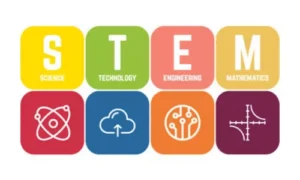
STEM stands for:
- S – Science
- T – Technology
- E – Engineering
- M – Mathematics
Each part of STEM helps children learn a different skill.
1. Science – Learning About the World
Science helps kids understand things like:
- Why the sky is blue
- How plants grow
- What happens when ice melts
- Why do day and night happen
Science encourages kids to ask “why” and “how” questions.
2. Technology – Using Tools the Smart Way

Technology encompasses more than just mobile phones and computers.
For kids, technology includes:
- Using simple machines
- Learning how tools work
- Understanding everyday gadgets
Technology teaches children how to use tools safely and wisely.
3. Engineering – Building and Creating

Engineering means:
- Building things
- Fixing problems
- Designing new ideas
Examples for kids:
- Building a bridge using blocks
- Making a paper boat
- Creating a tower using cups
Engineering improves creativity and problem-solving skills.
4. Mathematics – Playing With Numbers
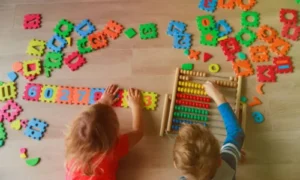
Math is everywhere in daily life:
- Counting toys
- Measuring water
- Telling time
- Identifying shapes
STEM makes math fun by using real-life examples instead of memorising formulas.
Why Is STEM Easy and Fun for Kids?
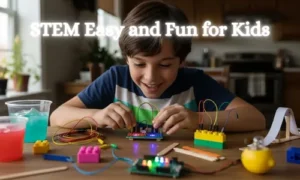
STEM learning:
- Uses games and activities
- Encourages curiosity
- Allows mistakes and learning
- Builds confidence
Kids enjoy STEM because it feels like play, not study.
How Parents Can Explain STEM to Kids
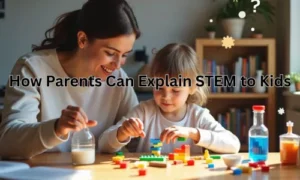
Parents can explain STEM by saying:
“STEM helps you learn how the world works and how to solve problems in a fun way.”
You can also:
- Let kids experiment
- Encourage questions
- Avoid giving ready answers
Simple support makes a big difference.
Conclusion
STEM is a powerful way for kids to learn naturally. When children understand STEM early, they become better thinkers, learners, and creators. Explaining STEM concepts in a simple way helps build a strong learning foundation.
FAQ – QUESTIONS & ANSWERS
1. What does STEM mean for kids?
STEM means learning science, technology, engineering, and math in a fun and simple way.
2. Is STEM only for school children?
No. STEM learning can start at home, even before school age.
3. Is STEM difficult to understand?
No. STEM concepts are taught using easy activities and daily-life examples.
4. Why should kids learn STEM?
STEM helps kids think better, solve problems, and become confident learners.
5. Can parents teach STEM without special knowledge?
Yes. Parents only need to encourage curiosity and exploration.