
Recently updated on January 7th, 2026 at 06:50 am
For Students, understanding force is one of the most important basics in physics.
You see force in action every day—when you open a door, kick a ball, or lift your school bag.
Force is not just a topic for exams.
It explains how things move, stop, change shape, or even stay at rest.
In this lesson, you will learn about force using simple words, daily-life examples, and exam-focused points.
No complex definitions—only a clear understanding.
What Is Force?

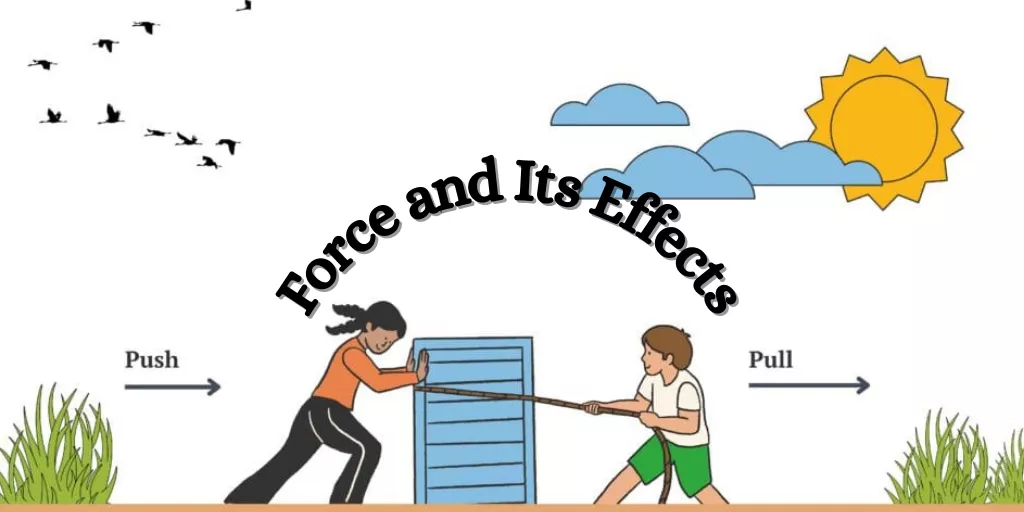
Force is simply a push or a pull.
Whenever you push something away from you or pull something towards you, you are applying force.
Force always comes from an interaction between two objects.
You cannot apply force without touching or affecting something.
Push Examples
Pushing a chair to move it forward
Pushing a door to close it
Pushing a trolley in a supermarket
Pull Examples
Pulling a bucket from a well
Pulling a drawer to open it
Pulling a rope in a tug of war
Exam Tip:
If a question asks “What is force?”, write:
Force is a push or a pull that can change the motion or shape of an object.
Can Force Act Without Touching?
Yes, some forces act without physical contact.
You do not always need to touch an object to apply force.
Examples
A magnet pulls iron objects
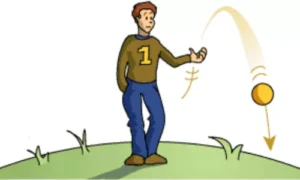
Gravity pulls objects toward Earth
Static electricity attracts bits of paper
These forces act from a distance.
They are also important in exams.
Effects of Force
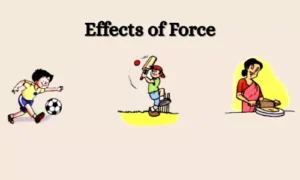
Force can affect objects in many ways.
This topic is commonly asked in 2–5 mark questions.
1. Force Can Change the Shape of an Object
When force is applied, an object may bend, stretch, or break.
Examples
Squeezing a rubber ball changes its shape
Stretching a rubber band makes it longer
Pressing clay changes its form
Exam Line:
Force can change the shape and size of an object.
2. Force Can Change the Speed of an Object
Force can make an object move faster or slower.
Examples
Pedalling harder makes a bicycle move faster
Applyingthe brakes slows down a moving car
Exam Line:
Force can increase or decrease the speed of a moving object.
3. Force Can Change the Direction of Motion
Force does not always change speed.
Sometimes it changes only the direction.
Examples
Hitting a moving cricket ball with a bat
Steering a car while driving
Kicking a football sideways
Exam Line:
Force can change the direction of a moving object.
4. Force Can Start Motion
A stationary object does not move unless a force is applied.
Examples
Pushing a stationary box
Kicking a ball at rest
Pushing a parked bicycle
Exam Line:
Force can make a stationary object start moving.
5. Force Can Stop a Moving Object
Force can also stop motion.
Examples
Applying the brakes to stop a bicycle
Catching a moving ball
Friction stops a sliding object
Exam Line:
Force can bring a moving object to rest.
Balanced and Unbalanced Forces
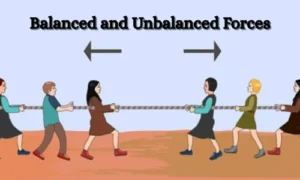
Balanced Forces
When two forces act in opposite directions with equal strength, motion does not change.
Example
Pushing a wall—it does not move
A book resting on a table
Balanced forces do not change motion.
Unbalanced Forces
When forces are unequal, motion changes.
Example
One team is pulling harder in the tug of war
Kicking a ball
Unbalanced forces cause movement or a change in motion.
Force in Daily Life
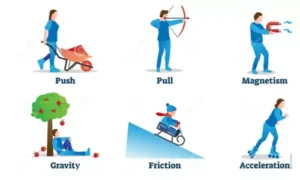
You use force many times a day without realising it.
Walking involves pushing the ground
Writing uses force between the pen and paper
Opening bottles needs a pulling or twisting force
Physics becomes easy when you observe real life.
Why Is Force Important for Students?

Force explains:
How vehicles move
Why objects fall
How machines work
Why sports need strength and control
This topic builds the base for future chapters like motion, work, and energy.
Common Exam Questions to Practice

What is force?
State any three effects of force.
Give two examples where force changes shape.
What is the difference between balanced and unbalanced forces?
Can a force act without touching? Explain with an example.
Key Points to Remember

Force = push or pull
Force can change shape, speed, direction, or motion
Balanced forces do not change motion
Unbalanced forces change motion
Examples are very important in answers
Conclusion
Force is not a difficult topic when you relate it to daily life.
Every movement around you is controlled by force.
Learn the effects, examples, and key terms, and you can easily score full marks.
Understanding force now will help you in many future physics chapters.
Exam-Oriented FAQs:
1. What is force?
Answer:
Force is a push or a pull that can change the shape, speed, direction, or state of motion of an object.
2. Write any three effects of force.
Answer:
Force can:
Change the shape of an object
Change the speed of a moving object
Change the direction of motion
3. Can force change the shape of an object? Give an example.
Answer:
Yes, force can change the shape of an object.
Example: When we squeeze a rubber ball, its shape changes.
4. What is the difference between balanced and unbalanced forces?
Answer:
Balanced forces do not change the motion of an object, while unbalanced forces cause a change in motion or direction.
5. Can a force act without touching an object? Give one example.
Answer:
Yes, force can act without touching an object.
Example: Gravity pulls objects toward the Earth without direct contact.