

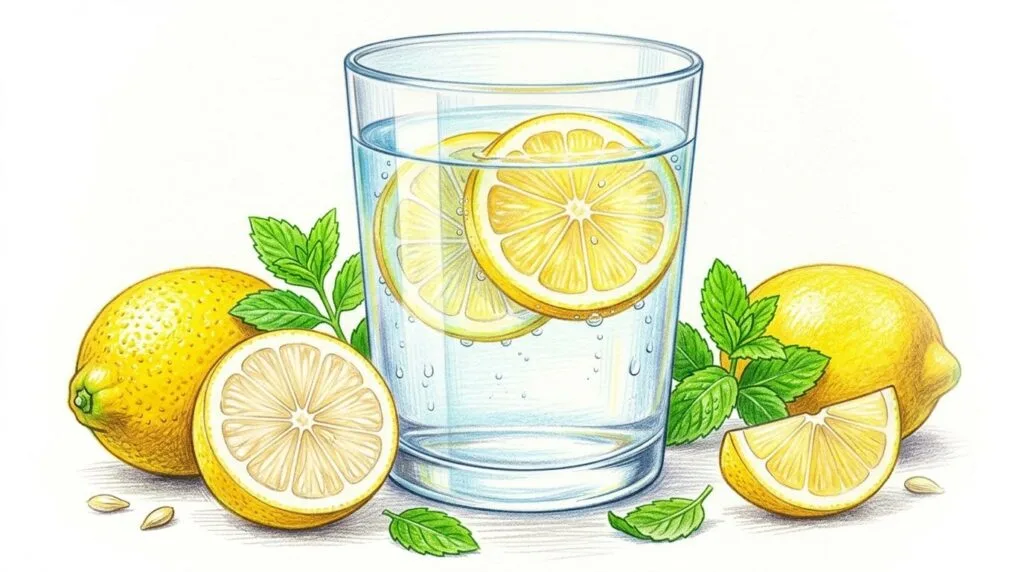
Lemon juice tastes sour because it contains acids, mainly citric acid. When citric acid dissolves in water, it releases hydrogen ions. These ions are responsible for many acidic properties, including sour taste, a low pH, and the ability to change the colour of some indicators.
In this lesson, we will understand what makes lemon juice acidic, how citric acid behaves in water, why lemon juice is called a weak acid, and how we can test its acidity safely.
Let Us Understand the Concept
What does acidic mean?

A substance is called acidic when it produces hydrogen ions in water. A hydrogen ion is represented by H+. In water, H+ does not usually remain alone. It attaches to a water molecule and forms a hydronium ion, H3O+.
Therefore, the acidic nature of a solution is connected with the presence of hydronium ions. The greater the concentration of hydronium ions, the more acidic the solution generally is. Acids often have a sour taste, react with some metals, and change the colour of acid-base indicators. However, students should never taste an unknown substance to test whether it is an acid.
Which acid is present in lemon juice?
The main acid in lemon juice is citric acid. Citric acid is a naturally occurring organic acid found in lemons, oranges, limes, and other citrus fruits. Lemon juice also contains water, sugars, minerals, flavour compounds, and small amounts of other substances. Although lemon juice contains vitamin C, or ascorbic acid, its sourness is mainly associated with citric acid rather than vitamin C alone.
Citric acid has the chemical formula C6H8O7. It is called an organic acid because it contains carbon and occurs naturally in living organisms and their food products. In a lemon, citric acid is produced as part of the plant’s chemical processes and accumulates in the fruit juice.
How does citric acid make lemon juice acidic?
Pure citric acid is a molecular substance. When it is added to water, some of its molecules transfer hydrogen ions to water molecules. A simplified equation for the first ionisation step is:
C6H8O7 + H2O ⇌ C6H7O7− + H3O+
The double arrow is important. It shows that the reaction is reversible and does not go completely in one direction. Citric acid gives some of its hydrogen ions to water, producing hydronium ions. These hydronium ions give lemon juice its acidic properties.
Citric acid can release up to three hydrogen ions in separate steps because it has three acidic hydrogen atoms. For school-level understanding, the most important idea is that citric acid reacts with water and increases the concentration of H3O+ ions.
Why is lemon juice a weak acid?
Lemon juice is acidic, but citric acid is a weak acid. This does not mean that lemon juice is harmless or that its acidity cannot be noticed. It means that citric acid ionises only partly in water. Many citric acid molecules remain as molecules instead of releasing all their hydrogen ions.
A strong acid, such as hydrochloric acid in a suitable laboratory solution, ionises almost completely in water. A weak acid, such as citric acid or ethanoic acid, ionises only partially. The words strong and weak describe the extent of ionisation, not simply how concentrated the solution is.
This distinction is important. A concentrated solution of a weak acid may contain more acid particles than a very dilute solution of a strong acid. Therefore, acid strength and acid concentration are different ideas.
What does pH tell us about lemon juice?
The pH scale is used to describe how acidic or basic an aqueous solution is. At a particular temperature, a pH of 7 is approximately neutral, values below 7 are acidic, and values above 7 are basic or alkaline. Lemon juice usually has a pH around 2 to 3, although the exact value can vary with the lemon variety, ripeness, and dilution.
A lower pH indicates a greater hydronium ion concentration. The pH scale is logarithmic, so a solution with pH 2 has about ten times the hydronium ion concentration of a solution with pH 3, under comparable conditions. Students do not need to memorise this comparison unless it is part of their syllabus, but they should remember that a decrease of one pH unit represents a tenfold change in hydronium ion concentration.
pH is not the same as the percentage of citric acid. The pH mainly describes the concentration of hydrogen or hydronium ions, while the total amount of acid present and the solution’s resistance to pH change involve additional ideas such as concentration and buffering.
Why does lemon juice taste sour?
Hydrogen ions and the acid molecules in lemon juice stimulate taste receptors on the tongue. The brain interprets this sensation as sourness. The sour taste is therefore a sensory response to the chemical composition of the juice. Taste is not a safe method for identifying unknown chemicals, because some dangerous substances may be poisonous, corrosive, or harmful without having an obvious taste.
Why does lemon juice change indicator colours?
Indicators are substances that show different colours in acidic and basic conditions. Blue litmus paper turns red in an acidic solution. Universal indicator gives a colour that can be compared with a pH scale, and lemon juice normally produces a colour in the acidic range.
Indicators work because their molecules have different colours in different chemical forms. The hydronium ions in lemon juice help shift the indicator molecules towards the form associated with acidic conditions.
What happens when lemon juice reacts with baking soda?
Baking soda is sodium hydrogen carbonate, with the formula NaHCO3. It is a mild base. When lemon juice reacts with baking soda, citric acid reacts with hydrogen carbonate ions. The reaction produces carbon dioxide gas, water, and a citrate salt. The bubbles and fizz are caused by carbon dioxide escaping from the mixture.
A simplified overall equation is:
C6H8O7 + 3NaHCO3 → Na3C6H5O7 + 3CO2 + 3H2O
This equation shows an acid-base reaction. It also explains why lemon juice and baking soda are sometimes used in classroom demonstrations. The gas formation is evidence that a chemical reaction is taking place, although the equation represents an idealised reaction in which the reactants are present in suitable proportions.
What happens when lemon juice is diluted?
Adding water to lemon juice reduces the concentration of citric acid and hydronium ions per unit volume. As a result, the diluted juice is less acidic and its pH usually rises, although it remains acidic if enough acid is still present.
Dilution does not remove the citric acid completely. It spreads the acid particles through a larger volume of water. This is why diluted lemon juice generally tastes less sour and produces a less strongly acidic indicator result.
How does lemon juice affect materials?
Acids can react with certain substances. Lemon juice can help dissolve some mineral deposits, such as limescale, because acids react with carbonate-containing materials. These reactions can produce carbon dioxide and soluble compounds. Lemon juice may also react slowly with some metals, especially if the metal surface is exposed for a long time.
Acidity can also affect food. Lemon juice can slow the browning of some cut fruits by changing the conditions around the enzymes involved in browning and by providing antioxidant compounds. This is a practical application of lemon juice, but it does not mean that lemon juice kills every microorganism or makes every food safe.
Important Scientific Terms and Their Meanings
| Scientific Term | Simple Meaning | Example or Explanation |
|---|---|---|
| Acid | A substance that increases hydronium ions in water. | Citric acid makes lemon juice acidic. |
| Citric acid | A weak organic acid found in citrus fruits. | It is the main acid responsible for lemon juice’s sour taste. |
| Hydrogen ion | A positively charged ion represented by H+. | It is transferred from an acid molecule to water. |
| Hydronium ion | An H+ ion attached to a water molecule. | Its formula is H3O+. |
| pH | A scale used to describe acidity or alkalinity. | Lemon juice usually has a pH between about 2 and 3. |
| Weak acid | An acid that ionises only partly in water. | Citric acid is a weak acid. |
| Ionisation | The formation of ions when a substance reacts with or dissolves in water. | Citric acid ionises partly and forms hydronium ions. |
| Indicator | A substance that changes colour in acidic or basic conditions. | Blue litmus turns red in lemon juice. |
| Base | A substance that can react with an acid and reduce its acidity. | Baking soda acts as a mild base. |
| Neutralisation | A reaction between an acid and a base. | Citric acid reacts with baking soda to form products including water. |
Examples or Activities
Testing lemon juice with indicator paper
Aim: To observe that lemon juice is acidic.
Materials required: A small amount of lemon juice, blue litmus paper, red litmus paper, and a clean dropper or glass rod.
Procedure:
- Place a small amount of lemon juice in a clean container.
- Put one drop of the juice on blue litmus paper.
- Observe the colour change.
- If desired, test a separate drop on red litmus paper.
Observation: Blue litmus paper turns red. Red litmus generally shows no obvious change because it is already the colour associated with acidic conditions.
Explanation: The hydronium ions produced by citric acid create acidic conditions, causing the indicator to change colour.
Conclusion: Lemon juice is acidic.
Use only small quantities and do not taste the test materials. Wash hands after the activity. A teacher or responsible adult should supervise younger students.
Lemon juice and baking soda
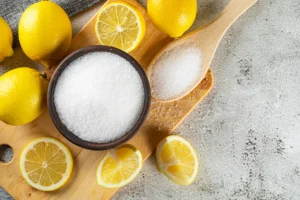
Place a small amount of baking soda in a cup and add a little lemon juice. Fizzing occurs because carbon dioxide gas is produced during the acid-base reaction. This activity demonstrates that acids can react with hydrogen carbonates and release carbon dioxide. Do not seal the mixture in a closed container, because the gas pressure could build up.
What Should We Understand from This Topic?
Lemon juice is acidic because it contains citric acid. In water, citric acid transfers some hydrogen ions to water molecules, forming hydronium ions. These ions are responsible for the acidic properties of the juice, including its low pH, sour taste, and reaction with indicators.
Citric acid is a weak acid because it ionises only partly in water. A weak acid does not mean no acid or no effect. The acidity of lemon juice depends on the amount and concentration of acid present. Dilution reduces the concentration of hydronium ions and makes the juice less acidic, while an indicator can provide visible evidence of its acidic nature.
Key Points to Remember
- The main acid in lemon juice is citric acid.
- Citric acid is a naturally occurring weak organic acid.
- Acids produce hydronium ions, H3O+, when they react with water.
- Lemon juice usually has a pH of about 2 to 3, though the value can vary.
- A pH below 7 indicates an acidic solution at ordinary school-level conditions.
- Citric acid is weak because it ionises only partly in water.
- Blue litmus turns red in lemon juice.
- Diluting lemon juice decreases the concentration of acid and hydronium ions.
- Lemon juice reacts with baking soda, producing carbon dioxide bubbles.
- Acid strength and acid concentration are different concepts.
Conclusion
Lemon juice is acidic because citric acid reacts with water to produce hydronium ions. These ions explain its sour taste, low pH, indicator colour changes, and reactions with substances such as baking soda. Understanding this example helps us connect an everyday food with important chemistry concepts such as acids, weak ionisation, pH, indicators, and neutralisation.