


Recently updated on January 9th, 2026 at 06:35 am
Physics helps us understand how things move around us. From a walking person to a rotating fan, motion is part of everyday life. For Students, learning motion becomes easy when we connect it with real-life activities instead of memorising definitions. Here, we will clearly explain the main types of motion in physics. Each type is explained in simple words with daily examples that Class 6–7 students can easily relate to.
What Is Motion?

An object is said to be in motion when it changes its position with time.
If something moves from one place to another, or even rotates or repeats its movement, it shows motion. Motion can be fast or slow, straight or curved, regular or irregular.
Physics studies motion to understand speed, direction, and patterns of movement.
1. Linear Motion

Linear motion is the simplest type of motion.
In linear motion, an object moves in a straight line from one position to another. The direction of movement remains unchanged.
This type of motion is easily observable in daily life.
Everyday Examples of Linear Motion
A car moving on a straight road
A person walking straight in a corridor
A train moving on a straight railway track
A ball rolling on a straight surface
Even if the speed changes, as long as the object moves in a straight path, it is considered linear motion.
Linear motion can be slow, like a crawling insect, or fast, like a racing bike.
2. Circular Motion
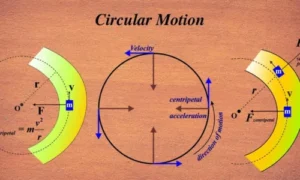
Circular motion happens when an object moves along a circular path.
In this motion, the object keeps changing its direction while moving around a fixed centre point. Even if the speed is constant, the direction is always changing.
That is why circular motion is different from linear motion.
Everyday Examples of Circular Motion
The blades of a ceiling fan
Hands of a wall clock
A merry-go-round in a park
The wheels of a moving bicycle
In circular motion, the object does not move in a straight line. It goes round and round along a curved path.
Circular motion is very common in machines and household objects.
3. Periodic Motion

Periodic motion is a type of motion that repeats itself at equal intervals of time.
If an object returns to the same position again and again after a fixed time, it shows periodic motion.
The movement follows a regular pattern.
Everyday Examples of Periodic Motion
Swinging of a pendulum
Movement of a playground swing
Beating of the human heart
Earth revolves around the Sun
The key idea in periodic motion is repetition. The motion repeats in the same way over and over again.
Not all repeated motions are fast. Some periodic motions are slow but very regular.
Difference Between Linear, Circular, and Periodic Motion

Understanding the differences helps students avoid confusion in exams.
Linear Motion
The path is straight
Direction does not change
Example: walking on a straight road
Circular Motion
The path is circular
The direction keeps changing
Example: rotating fan
Periodic Motion
Motion repeats after a fixed time
Can be straight or curved
Example: swinging pendulum
Sometimes, one motion can belong to more than one category.
For example, a clock hand shows both circular motion and periodic motion.
Why Should Students Learn About Motion?

Motion is one of the first topics in physics because it builds the foundation for future concepts.
Learning motion helps students:
Understand how objects move
Learn about speed and distance
Connect physics with real life
Score better in science exams
Motion is not just a chapter. It explains the world around us in a logical way.
Once students understand motion, topics like force, energy, and gravity become easier.
Common Mistakes Students Make

Many students mix up circular and periodic motion.
Remember:
Circular motion does not always repeat in equal time
Periodic motion must repeat regularly
Another mistake is thinking motion only means fast movement. Slow movement is also motion.
Even a snail crawling shows motion.
Motion Around Us: Simple Observation Activity

Try this at home.
Observe your surroundings for five minutes and note:
One object in linear motion
One object in circular motion
One object in periodic motion
This small activity helps students understand physics without textbooks.
Common Mistakes Students Make in Types of Motion
1. Confusing Uniform Motion with Uniform Speed
Many students think uniform motion means “same speed only.”
But uniform motion means an object covers equal distances in equal intervals of time in a straight line.
Example mistake:
A car moving in a circle at constant speed is often called uniform motion.
Wrong — direction changes, so it is not uniform motion.
2. Mixing Up Periodic Motion and Oscillatory Motion
Students often assume both are the same.
Periodic motion: Any motion that repeats after a fixed time.
Oscillatory motion: Motion to and fro about a mean position.
Example mistake:
Earth revolving around the Sun is called an oscillatory motion.
Wrong — it is periodic, not oscillatory.
3. Thinking Circular Motion Is Always Uniform
A very common misconception is that all circular motion is uniform.
Example mistake:
A fan starting from rest is said to be in uniform circular motion.
Wrong — speed changes initially, so motion is non-uniform circular motion.
Uniform circular motion happens only when speed remains constant.
4. Confusing Random Motion with Irregular Motion
Students often use these terms interchangeably.
Random motion: No fixed path or direction (e.g., motion of gas molecules).
Irregular motion: Motion without equal time or distance intervals but still along a path.
Example mistake:
A zig-zag moving car is called random motion.
Wrong — it is irregular, not random.
5. Forgetting Direction in Rectilinear Motion
Many students focus only on distance and forget direction.
Example mistake:
Any straight-line movement is called rectilinear motion, even if direction changes.
Wrong — rectilinear motion requires motion along a straight line without changing direction.
6. Misidentifying Rotational Motion as Circular Motion
This is a classic exam mistake.
Rotational motion: The object rotates about its own axis.
Circular motion: Object moves along a circular path around another point.
Example mistake:
A spinning top is said to be in circular motion.
Wrong — it shows rotational motion.
Exam Tip for Students
If you are asked to identify the type of motion, always check:
Path of motion
Speed (constant or changing)
Direction of motion
Whether it repeats after equal time
This avoids most mistakes in Types of Motion questions.
Conclusion
Motion is everywhere. From morning alarms to evening walks, everything around us moves in one way or another.
By understanding linear, circular, and periodic motion, students can easily relate physics to daily life. Learning motion with examples makes the subject interesting and less stressful.
Physics becomes simple when we observe, think, and connect concepts with real experiences.
Exam-Oriented FAQs: Types of Motion in Physics
1. What is motion in physics?
Motion is the change in position of an object with time. If an object moves from one place to another, it is said to be in motion.
2. What is linear motion? Give one example.
Linear motion is the motion of an object along a straight path.
Example: A car moving on a straight road.
3. Why is the motion of a ceiling fan called circular motion?
The blades of a ceiling fan move along a circular path around a fixed centre. Since the direction keeps changing, it is called circular motion.
4. What is periodic motion? Write one daily life example.
Periodic motion is a motion that repeats itself after equal intervals of time.
Example: The swinging of a pendulum.
5. Can an object show more than one type of motion at the same time? Explain.
Yes. An object can show more than one type of motion.
Example: The hands of a clock show both circular motion and periodic motion.