


Recently updated on December 23rd, 2025 at 09:56 am
Best Study Timetable to Score Good Marks in Exams isn’t about studying for long hours—it’s about studying smart. With a well-structured study timetable, you can stay consistent, use your time wisely, reduce stress, and boost your learning efficiency. Whether you’re preparing for school exams, board exams, or competitive tests, a clear daily routine can greatly improve your overall performance. This guide shares the best study timetable to score good marks in exams, along with practical, easy-to-follow tips for students of every level.
Why You Need a Study Timetable

A timetable gives you:
- Better focus
- Equal attention to all subjects
- Enough time for revision
- Improved productivity
- Reduced exam stress
A good timetable turns your preparation from confusion to clarity.
Best Daily Study Timetable for Students

Early Morning (5:00 AM – 7:00 AM)
Best time for learning new concepts
- Fresh mind = better concentration
- Start with difficult subjects like Math, Science, or Accounts
- Study 1 main subject + practice questions
Morning Session (8:00 AM – 10:00 AM)
Focus study with high retention
- Read theory subjects (Biology, Social Studies, Economics)
- Make short notes
- Practice diagrams, charts, or formulas
Afternoon Session (2:00 PM – 4:00 PM)
Light & revision-based work
- Revise what you studied in the morning
- Solve previous papers or mock tests
- Watch educational videos if required
Evening Session (6:00 PM – 8:00 PM)
Perfect for practice-oriented study
- Solve problems, writing practice, or numericals
- Complete homework or assignments
Night Session (9:00 PM – 10:00 PM)
End your day with revision
- Revise formulas, notes, or 1-page summaries
- Plan next day’s timetable
- Sleep at least 7 hours
Weekly Study Plan to Score Good Marks

Monday – Friday
- Daily study routine as above
- 1 hour extra for weak subjects
- Attempt one mini-test (20–30 mins)
Saturday
- Full revision day
- Solve previous question papers
- Identify mistakes
Sunday
- Light study
- Mind relaxation
- Re-arrange notes
- Plan next week
How Many Hours Should You Study Daily?

- Class 6–8: 2–3 hours
- Class 9–10: 3–4 hours
- Class 11–12: 4–6 hours
- Competitive exam aspirants: 6–8 hours
Remember: Consistency > Long hours
Smart Study Tips to Score Good Marks

1. Follow the 50-10 Rule
- Study 50 minutes → Break 10 minutes
2. Prioritise difficult subjects first
- Morning is best for tough topics.
3. Make short notes
- Helps in last-minute revision.
4. Practice previous question papers
- 80% of exam patterns repeat.
5. Avoid multitasking
- Focus on one subject at a time.
6. Keep your study area clean & distraction-free
- The environment influences productivity.
7. Sleep well
- Better memory retention when your brain is rested.
Revision Plan (Very Important)
- Daily Revision: 20–30 minutes
- Weekly Revision: 2–3 hours
- Monthly Revision: 1 full day
Revision improves your marks more than new learning.
Sample Study Timetable (Ready to Use)
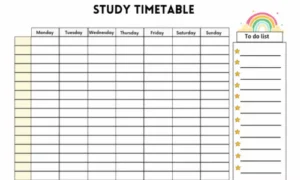
| Time | Activity |
|---|---|
| 5:00–7:00 AM | Tough subjects (Math/Science) |
| 8:00–10:00 AM | Theory subjects |
| 2:00–4:00 PM | Revision & practice |
| 6:00–8:00 PM | Problem solving & homework |
| 9:00–10:00 PM | Quick revision & planning |
FAQs: Best Study Timetable to Score Good Marks in Exams
1. Why is a study timetable important for scoring good marks?
A study timetable helps students manage time effectively, study consistently, reduce stress, and cover the entire syllabus before exams.
2. What is the best study timetable for students?
The best study timetable is one that balances study time, revision, breaks, and sleep while matching the student’s daily routine and energy levels.
3. How many hours should students study daily?
Study hours depend on the student’s class and exam level, but 4–6 focused hours with breaks are effective for most students.
4. Should students study all subjects every day?
Not necessarily. Students can rotate subjects daily while ensuring each subject is covered regularly throughout the week.
5. Is early morning study better than late-night study?
Early morning study is often more effective because the mind is fresh, but students should choose a time when they can focus best.
Conclusion
A perfect study schedule is the foundation for achieving high grades. When you adhere to a systematic daily and weekly regimen, revision becomes easier, topics become clearer, and exam confidence organically grows. Consistency, planning, and smart study—these three factors ensure success.
Begin using this timeline immediately and feel the difference in your preparation!