

Every child learns differently at different ages. STEM learning education works best when it is age-appropriate and fun. Teaching advanced concepts too early can confuse children, while simple activities at the right age can build strong learning foundations.
This age-wise STEM learning guide helps parents and teachers understand what kind of STEM learning is suitable for children aged 3 to 10 years.
1. STEM Learning for Ages 3–4 (Early Explorers)
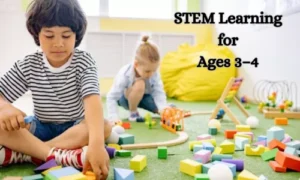
At this age, children learn through touch, play, and observation.
Best STEM activities:
- Playing with blocks and shapes
- Sorting toys by colour or size
- Water play to understand floating and sinking
- Asking simple “why” questions
Focus areas:
- Curiosity
- Motor skills
- Basic observation
2. STEM Learning for Ages 5–6 (Curious Learners)
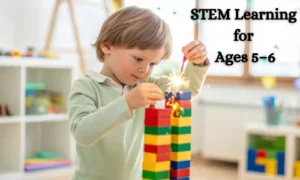
Children begin to understand simple logic and patterns.
Best STEM activities:
- Counting objects
- Simple science experiments (mixing colours)
- Building small structures with blocks
- Identifying patterns and shapes
Focus areas:
- Problem-solving
- Early math skills
- Asking better questions
Learning should still feel like play, not study.
3. STEM Learning for Ages 7–8 (Thinkers in Action)
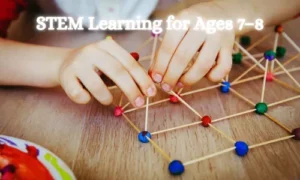
Children can now follow steps and understand cause and effect.
Best STEM activities:
- DIY science experiments
- Measuring ingredients while cooking
- Simple coding games (unplugged)
- Building models using household items
Focus areas:
- Logical thinking
- Understanding instructions
- Creativity
Mistakes should be encouraged as part of learning.
4. STEM Learning for Ages 9–10 (Young Problem Solvers)
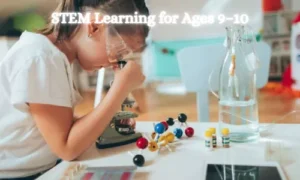
Children start thinking independently and analytically.
Best STEM activities:
- Project-based learning
- Simple robotics or coding basics
- Math puzzles and brain games
- Science fair projects
Focus areas:
- Independent thinking
- Planning and execution
- Real-world problem solving
This is a strong age to build confidence and curiosity.
What Parents Should Remember
- Every child learns at their own pace
- STEM should be fun, not forced
- Praise effort, not just results
- Allow children to ask questions
STEM learning works best when children feel safe to explore and fail.
How Age-Wise STEM Builds Strong Foundations
When STEM learning matches a child’s age:
- Concepts become easier
- Confidence increases
- Fear of science and math reduces
- Learning becomes enjoyable
Age-appropriate STEM creates lifelong learners, not rote learners.
Conclusion
STEM education is most effective when it grows with the child. From playful exploration at age 3 to problem-solving at age 10, age-wise STEM learning builds curiosity, creativity, and confidence step by step.
FAQ – QUESTIONS & ANSWERS
1. Why is age-wise STEM learning important?
Because children understand concepts better when learning matches their age and ability.
2. Can STEM learning start at age 3?
Yes. STEM can start through play-based activities and exploration.
3. Is STEM learning stressful for kids?
No, if it is age-appropriate and activity-based.
4. Do kids need gadgets for STEM learning?
No. Many STEM activities can be done without screens or devices.
5. How can parents support age-wise STEM learning?
By choosing simple activities, encouraging curiosity, and avoiding pressure.