

Recently updated on January 31st, 2026 at 02:46 pm
The Laws of Motion form the foundation of physics.
Almost every topic in mechanics—motion, force, momentum, vehicles, even sports—starts from these laws.
Students often feel scared when they hear “laws of motion” because they expect:
Difficult formulas
Long derivations
Complex numericals
But here’s the truth
The laws of motion are mostly about common sense and daily life.
In this article, you will learn:
Newton’s three laws in straightforward words
Easy real-life examples
Where do these laws come in exams
Zero maths, zero stress
Who Gave the Laws of Motion?
The laws of motion were given by Isaac Newton, a famous scientist.
He observed how objects move in real life and summarised them into three simple laws.
What Are the Laws of Motion?
The three laws of motion explain:
Why do objects stay still or keep moving
How force changes motion
Why does every action have a reaction
Let’s understand each law slowly and clearly.
Newton’s First Law of Motion
Statement
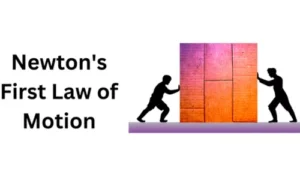
An object will remain at rest or continue moving in the same straight line unless an external force acts on it.
What This Means in Simple Words
Objects don’t change their motion on their own
A force is needed to:
Start motion
Stop motion
Change direction
This law is also called the Law of Inertia.
Real-Life Examples of First Law
A book lying on a table stays there until pushed
Passengers fall backwards when the bus starts suddenly
A football stops only because friction acts on it
If no force acts, motion does not change.
Newton’s Second Law of Motion
Statement
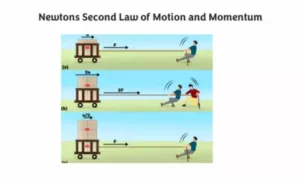
The change in motion of an object depends on:
How strong the force is
How heavy the object is
What This Means in Simple Words
Stronger force → bigger effect
Heavier object → harder to move
Force decides how fast, how slow, or how strongly an object moves.
Real-Life Examples of the Second Law
Kicking a ball softly vs kicking it hard
Pushing an empty trolley vs a loaded trolley
A truck takes longer to stop than a bicycle
Same push, different results—because mass is different.
Newton’s Third Law of Motion
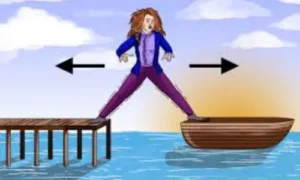
Statement (Simple Version)
For every action, there is an equal and opposite reaction.
What This Means in Simple Words
Forces always come in pairs
When you push something, it pushes back on you
You may not notice the reaction, but it is always there.
Real-Life Examples of Third Law
Walking: you push the ground backwards, the ground pushes you forward
Swimming: you push water backwards, water pushes you forward
Jumping: you push the ground down, the ground pushes you up
Without a reaction force, motion is impossible.
All Three Laws at a Glance
| Law | Main Idea | Simple Example |
|---|---|---|
| First Law | Motion doesn’t change without force | Falling backwards in a starting bus |
| Second Law | Force changes motion | Hard kicks the ball farther |
| Third Law | Action–reaction pair | Walking on the ground |
Daily Life Examples
Where Do Laws of Motion Come in Exams?

This is very important for scoring marks.
1. Short Answer Questions
Examples:
State Newton’s first law
Give one example of the third law
What is inertia?
2. Reason-Based Questions
Examples:
Why do passengers fall forward when a bus stops suddenly?
Why is it difficult to push a loaded cart?
Concept-based, no maths required
3. Assertion–Reason Questions
Often asked in:
Board exams
Competitive exams
Example idea:
Assertion: A heavier object is harder to move
Reason: It has more inertia
4. MCQs
Common MCQ themes:
Identifying the correct law
Matching the example with the law
Choosing the correct statement
5. Long Answer (Without Maths)
Examples:
Explain Newton’s laws with examples
Explain the third law using daily life
Clear explanation = full marks
Why Students Fear Laws of Motion
1. Fear of Formulas
Students think laws = equations.
But concepts come before maths.
2. Memorising Without Understanding
Rote learning confuses application questions.
3. Not Linking with Daily Life
Physics becomes easy when you see it around you.
How to Study Laws of Motion Easily
Read one law at a time
Imagine a real situation
Use your own examples
Focus on why, not formulas
Quick Revision Points

First law → inertia
Second law → force changes motion
Third law → action–reaction
No force → no change
Forces always act in pairs
One-Line Exam Answers
First law: Objects resist change in motion
Second law: Force controls motion
Third law: Every action has a reaction
Conclusion
The laws of motion are not difficult—they are logical rules of everyday life.
Once you understand:
Why buses jerk
Why balls move
Why is walking possible
You already understand Newton’s laws.