


Recently updated on December 23rd, 2025 at 09:44 am
Preparing for exams becomes much easier when you follow the right revision Techniques. Many students study hard but still forget concepts during the exam because they revise incorrectly. Effective revision strengthens memory, keeps concepts fresh in your mind, reduces exam stress, and boosts confidence.
This guide will teach you the finest revision tactics for remembering everything and scoring well on any exam, including school tests, board exams, and competitive exams.
Also See: How to Score Good Marks in Exams
1. Use Active Recall: The Most Powerful Technique

Active Recall means testing yourself instead of re-reading notes. Research shows that self-testing improves memory significantly.
How to use Active Recall
- Close your book and try to answer a question from memory.
- Write what you remember before checking the answer.
- Use practice tests and quizzes.
Why it works: Your brain becomes stronger at retrieving information during the actual exam.
2. Apply Spaced Repetition for Long-Term Memory
Spaced Repetition means revising at regular intervals instead of cramming everything at once.
Revision schedule example
- 1st revision → After 24 hours
- 2nd revision → After 3 days
- 3rd revision → After 7 days
- 4th revision → After 21 days
Why it works: Spacing helps your brain store information in long-term memory.
3. Teach Someone Else (Feynman Technique)

One of the best ways to remember a concept is to explain it in simple words.
How to use:
- Teach your friend or sibling.
- Pretend you are teaching in front of a mirror.
- Explain concepts in simple language.
Why it works: Teaching forces your brain to understand, simplify, and recall information deeply.
4. Create Mind Maps and Flowcharts
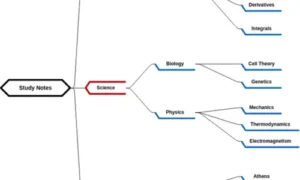
Mind maps visually connect topics, making it easier to remember complex concepts.
Benefits:
- Helps you revise entire chapters in minutes.
- Makes relationships between topics clear.
- Enhances creativity and memory.
Use colours, symbols, and arrows to make them more memorable.
5. Solve Previous Year Papers and Mock Tests

Mock tests simulate real exam pressure and improve your time management.
Why you should do them:
- Helps you identify weak areas.
- Improves speed and accuracy.
- Makes you familiar with exam patterns.
Try to solve at least one paper every week.
6. Use the Pomodoro Technique for Smart Revision
Study for 25 minutes → take a 5-minute break → repeat.
After 4 cycles, take a longer break.
Benefits:
- Prevents burnout
- Keeps your focus sharp
- Helps you revise more in less time
7. Make Short Notes for Quick Recap

Short notes are essential for last-minute revision.
What to include:
- Formulas
- Definitions
- Important dates
- Key points
- Diagrams
Write in your own words to improve retention.
8. Revise with Flashcards
Flashcards are excellent for memorising terms, formulas, vocabulary, and definitions.
Tips:
- Use apps like Anki or Quizlet.
- Keep the flashcards short.
- Revise daily for a few minutes.
9. Study in Small Chunks (Chunking Technique)
Break big chapters into small, understandable sections.
Why it helps:
- Makes learning less overwhelming.
- Easier to remember and revise.
- Helps your brain organise information better.
10. Stay Healthy—Your Brain Needs Energy

Revision is most effective when your mind and body are in good condition.
Do this:
- Sleep 7–8 hours
- Drink enough water
- Eat brain-boosting foods like nuts, fruits, and vegetables
- Take short breaks
- Reduce screen time before bed
A fresh mind remembers more.
FAQs: Top Revision Techniques to Remember Everything for Exams
1. Why is revision important for exams?
Revision helps strengthen memory, improve understanding, and reduce forgetting. It allows students to recall information quickly during exams.
2. What are the best revision techniques for students?
Some of the best revision techniques include:
- Regular revision
- Active recall
- Practice tests
- Short notes and summaries
3. How often should students revise their subjects?
Students should revise important topics weekly and do a final revision closer to exams to retain information effectively.
Final Tips to Remember Everything

- Revise daily instead of last-minute studying.
- Mix different revision techniques for better memory.
- Track your progress using a study planner.
- Stay positive and confident.
With the right revision techniques, scoring high becomes much easier. Start applying these methods today and see the difference in your exam performance.